Uvita: Along the Marino Ballena Coast | Costa Rica Travel Professionals
Travel Stories
Uvita: Along the Marino Ballena Coast
The tide was still making up its mind when I reached the sand at Uvita. Water ran in thin silver seams between the small ridges my shoes had pressed into the beach. Ahead of me, the Pacific looked almost still from a distance, yet
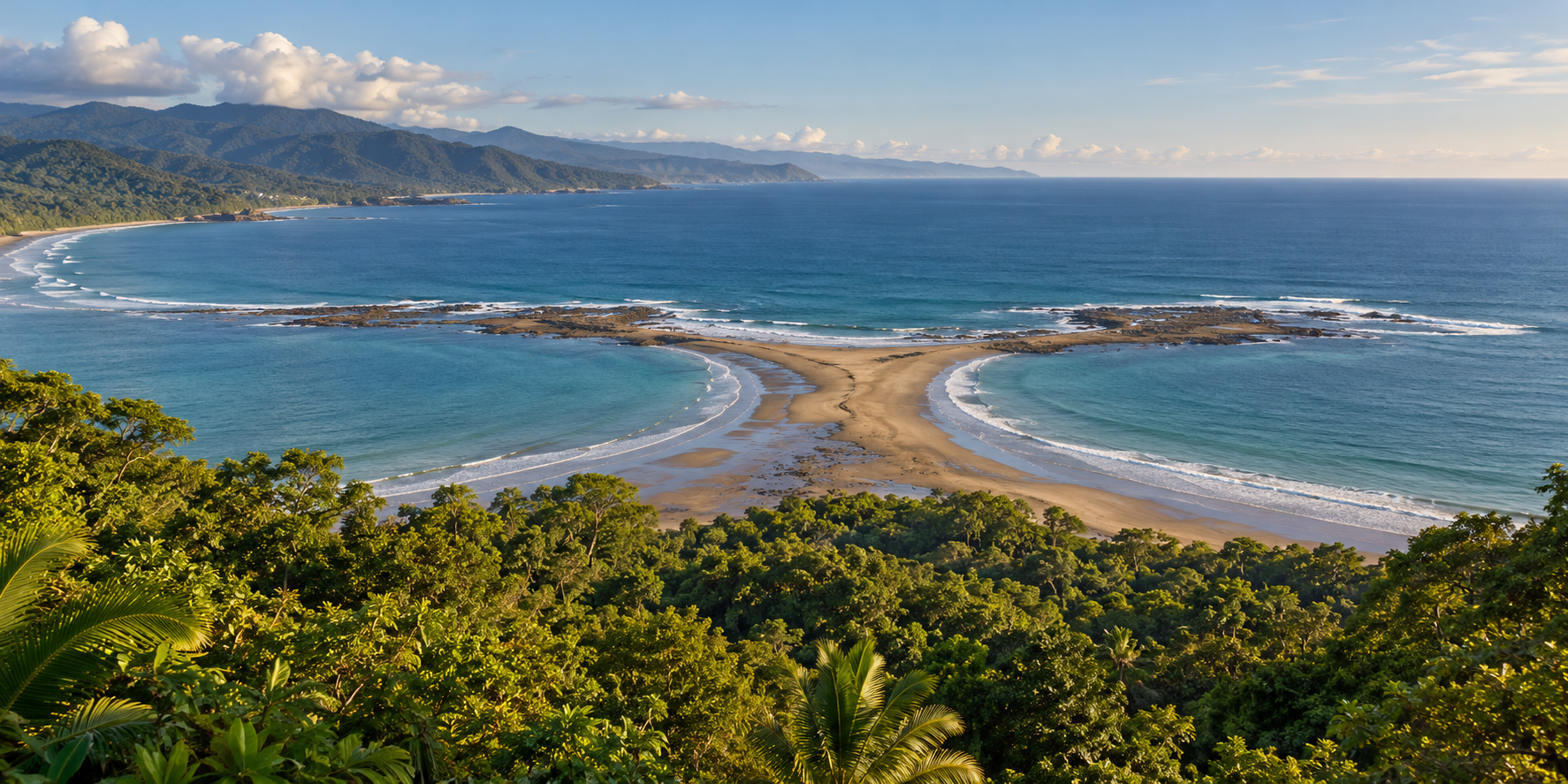
Illustrative AI-generated image created for this story; it is not a documentary photograph.
The tide was still making up its mind when I reached the sand at Uvita. Water ran in thin silver seams between the small ridges my shoes had pressed into the beach. Ahead of me, the Pacific looked almost still from a distance, yet each wave rearranged the edge of the shore. Behind the beach, green rose in layers. I had come to the South Pacific for the famous shape on a map, a narrow strip of sand and rock called the Whale’s Tail. Standing at ground level, I could see no tail at all. I saw a broad, changing coast that seemed to ask me to pay attention before it would reveal anything.
That felt like a better beginning than the photograph I had imagined. I had pictured myself arriving at the perfect angle, the entire geological shape neatly framed beneath me. Instead I had a horizon, a tide, and the modest task of learning when it was safe to walk. At the park entrance I would check the tide information and follow the rangers’ guidance; the tail can be reached only at low tide. The sea determines the timing here. No itinerary, however carefully planned, can make it reverse course.
I walked slowly enough to hear the difference between wet sand and dry. The wet sand made a low hush beneath my feet. On the higher beach, grains shifted and scratched. A small shorebird ran ahead of a wave and doubled back to investigate what the water had uncovered. I stopped to watch it, then noticed how easily I had almost walked past it while searching for something bigger. Marino Ballena National Park protects an entire marine and coastal landscape, not just the formation that draws cameras. The coastline, mangroves, islands, and offshore waters are parts of the same story.
The shape that changes with the water
As the tide fell, the beach appeared to widen. It was not a dramatic unveiling. More sand simply stayed visible after each wave withdrew. The walk toward the rocky end of the formation became possible by degrees, which made me think about how misleading a fixed picture can be. A photograph holds the Whale’s Tail in one confident instant. On the ground, it is a negotiation between water, weather, stone, and the time of day.
I wanted to rush to the farthest point. The broad sand seemed to invite it, and I could see other walkers drawing away in the distance. But I kept thinking of the returning tide. I did not need to prove that I could reach the end. I needed enough time to walk back without hurrying, and I wanted the freedom to stop. The park’s advice to consult the tide table and pay attention to currents sounded less like a caution pasted onto an adventure and more like the key to enjoying it.
At one point I turned around. From that direction the land looked entirely different: palms and forest stood behind the beach, and the pale corridor of sand drew my eye back toward them. The sight made me understand why a day here cannot be reduced to a single aerial view. The celebrated shape belongs to a larger place, one with shade at its margins and life moving through the boundary between fresh water and salt.
The rocks underfoot changed the rhythm of the walk. Where the beach had let me look outward, the rougher ground asked me to look down. Pools caught reflections of clouds. Water gathered in crevices. I left the small living things in and around them alone. It was tempting to crouch for a closer view, but I could enjoy the details without touching or moving anything. The park’s protection is meaningful only if the many people who come to see it allow its creatures and habitats to remain as they are.
There was no moment when the shape suddenly became legible from my own height. I liked that. I knew the peninsula of sand and rock could resemble a whale’s tail from above, but from the beach I experienced its breadth, texture, and exposure. A place can be famous for one image and still have a quieter reality that asks for a different kind of attention. I took a photograph of the low water sliding over the sand, with no attempt to pretend that my camera had found a view it could not have found.
What the coast holds
The park's name made me think of whales, of course. Humpbacks use these waters during seasonal migrations, and the park also protects habitat for dolphins and other marine life. I did not turn the walk into a search for a guaranteed sighting. Wildlife is not a scheduled performance, and the ocean kept its larger animals beyond my view. I found that the possibility of their presence changed how I looked at the water anyway. The horizon was no longer empty; it was simply unreadable from shore.
I sat where I could see a sequence of waves arrive and break. Each one looked similar until I paid closer attention. One reached farther up the sand. Another met an outgoing ribbon of water and rose in a quick, clear fold. Farther offshore, light shifted across the surface in patches. The landscape had a scale that was difficult to hold in one thought: a bird searching the waterline, a rocky point at my feet, migrating animals somewhere in the marine world beyond.
I had initially thought of a boat excursion as the defining way to meet this coast. It could be a memorable choice with a responsible local operator, especially for someone who hopes to learn about the park’s marine environment. But it did not need to be the only choice. My walk had already made the place feel alive. It also reminded me that any excursion would come with responsibility: to give wildlife space, to follow the rules that protect it, and to accept that a day without a sighting can still be a beautiful day on the water.
Back near the greener edge of the beach, the air seemed to change. The open shore had been all light and salt; near the vegetation, I became aware of leaves moving above the steady surf. The park includes more than the best-known beach. Its official description lists several beaches and coastal environments, from rocky sections to mangroves and forest. I would not claim to know all of them after one walk. It was enough to see the landscape refuse a simple label. This was not merely a beach stop, and it was not only a whale-watching address. It was a meeting of habitats.
I thought about the people whose concern for the marine environment helped bring the park into being. Conservation can sound abstract when it is printed in a brochure. Here it had a very physical meaning. A protected stretch of coastline gives fish, birds, marine mammals, plants, and people a different future from the one they might have had without it. It also sets limits for visitors. I could admire a tide pool without collecting its contents, carry my own waste back out, and take care near currents. Those small decisions were part of my visit, not an interruption to it.
An afternoon without a checklist
I left the sand for a while and sat with a cold drink in the shade, still finding grains of sand along my ankles. The simplest part of the day stayed with me most: the gradual widening of the shore, the bird’s quick footsteps, the sound of a wave arriving behind me while I studied a pool of water. I had not filled the hours with named activities. I had allowed one place enough room to become more than its headline.
Later I returned to a safe point on the beach and watched the water begin to reclaim the space I had crossed. The transformation was subtle until I compared it with the morning. The wide, walkable corridor seemed less certain. What had looked like a route was becoming sea again. It would have been easy to speak of the tide as if it were changing the plans for my day. In truth, the tide was the day. My plans were the temporary thing.
The light softened over the coast. I tried to picture the Whale’s Tail from above, then let the idea go. The view I had earned was lower and more intimate. I knew where the ground had changed from sand to stone. I knew how the water had moved around my feet. I knew how far the forest appeared when I was walking toward the point and how close it felt on the way back. A famous landmark had turned into a sequence of moments instead of a shape to collect.
For a traveler planning a longer journey, Uvita offers a useful pause in the South Pacific. One could pair a visit to Marino Ballena with other days along the coast, or give this area more time than a single morning. The right choice would depend on the tide, the season, the weather, and what kind of pace feels restful. A specialist could help fit those pieces together. I would not want a plan that promised a whale at a certain hour or treated the exposed tail as available at any time. I would want a plan that left space for the place to be itself.
That night, what returned to me was not the aerial outline from the guidebook. It was the sensation of waiting for the water to draw back and realizing that waiting was already an experience. I had gone to Uvita expecting an emblem. I left thinking about movement: water making and unmaking a path, shorebirds following its edge, distant migrations crossing the same sea, and a traveler learning to step into that rhythm without trying to control it.
I also thought about how I would describe this day to someone who had never seen the South Pacific. I could tell them about the whale-shaped formation, and I would. Yet I would first describe the odd pleasure of finding no shortcut to the best part. I would describe the changing surface under my feet and the relief of letting a schedule loosen. I would tell them that the park deserves time for an unhurried return as well as the outward walk. The story would begin and end with the same simple observation: here, the coast is always doing something, even when I am standing still.
The next morning could have brought a different sky, a different tide, or a different choice of beach. That uncertainty was part of the invitation. Marino Ballena had given me something less tidy than a postcard and much more lasting: the sense that a coastal journey is richest when I notice what is present, respect what is protected, and leave room for what I cannot predict.
Editorial note: This first-person travel story is an illustrative, researched narrative created for inspiration. It does not describe an actual visit by a Costa Rica Travel Professionals staff member or customer. The accompanying image is AI-generated and illustrative.
A world of wonder awaits
Plan your Costa Rica adventure
Tell our destination concierges what you want from Costa Rica, and we will help shape the journey.