Tamarindo: Estuary and Pacific Sunset | Costa Rica Travel Professionals
Travel Stories
Tamarindo: Estuary and Pacific Sunset
Tamarindo was already awake when I reached the beach. The light had barely cleared the rooftops, but the town was gathering itself around the morning: a few people carrying boards, a few others walking with no equipment at all, an
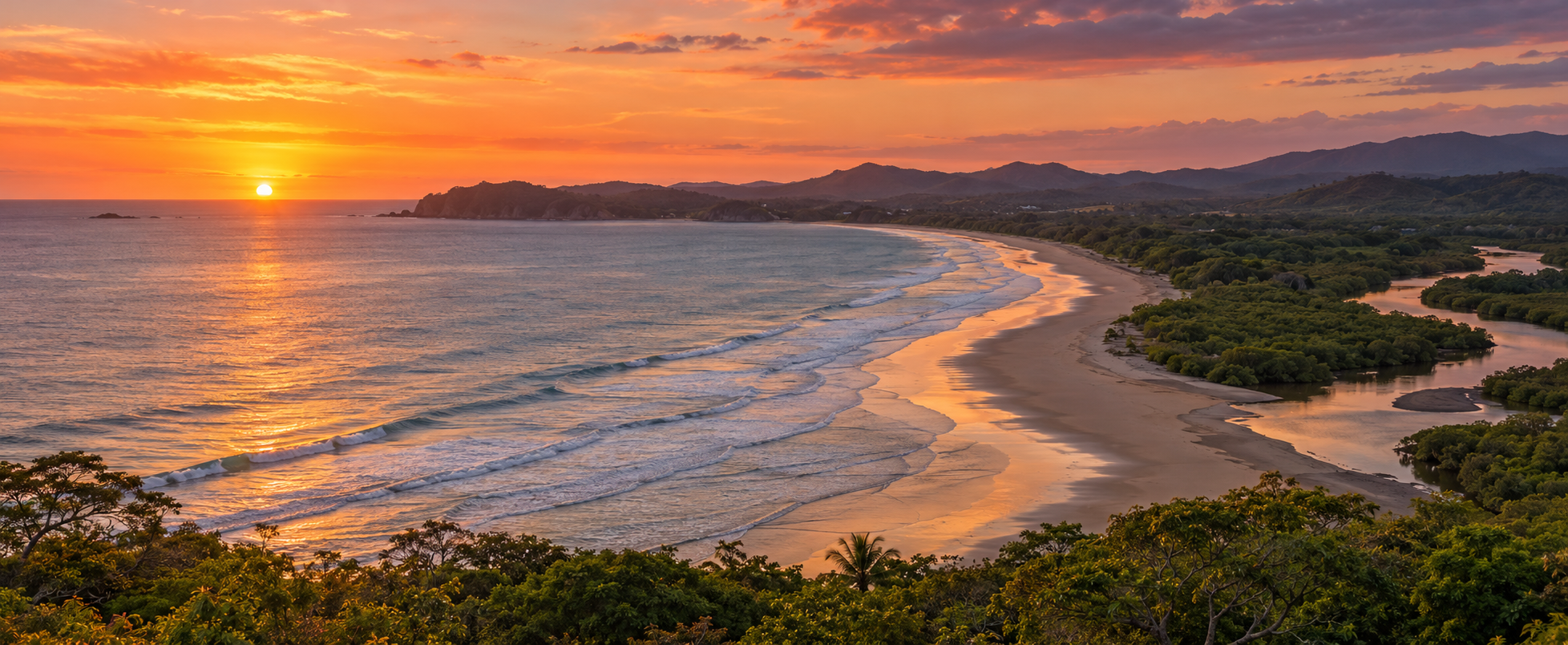
Illustrative AI-generated image created for this story; it is not a documentary photograph.
Tamarindo was already awake when I reached the beach. The light had barely cleared the rooftops, but the town was gathering itself around the morning: a few people carrying boards, a few others walking with no equipment at all, and the steady sound of the Pacific beyond them. I had expected the beach to be the whole story. It was the first thing I saw, and it filled the horizon. Yet the most interesting part of my day began when I turned away from that open water and looked toward the quieter edge where the estuary meets the sea.
The two waters gave me different ways to pay attention. On the beach, everything seemed to happen at a distance and all at once. Waves rose across a wide field of blue. Surfers judged their timing. A cloud's shadow moved over the bay. At the estuary, I needed to look into a narrower world: the line of mangroves, the reflections interrupted by a slight current, the way a bird might pause on a branch and disappear against it. I liked that a place known for sun and surf could also ask for this slower kind of looking.
I did not go searching for a particular animal. The estuary's mangroves support life whether or not I can identify it from one visit. I would choose a responsible local guide if I wanted to explore the channels more deeply, and I would let that person's knowledge shape the route. That morning, I stayed at a respectful distance and watched the meeting of water and roots. There was no need to turn a quiet habitat into a list of sightings. The change in sound alone was enough: surf on one side, a smaller movement of water on the other.
The Costa Rica Tourism Board describes Tamarindo Bay together with its estuary and mangrove area. Seeing the two in the same day made that description feel less like geography and more like a relationship. The coast did not stop where the sand ended. It folded inland, carrying salt water into channels where plants had adapted to its presence. The beach was the public face of Tamarindo; the estuary felt like a more private conversation. I wanted to listen without interrupting it.
A town between moods
When I turned back toward the beach, Tamarindo felt busier. That was part of its appeal. I could imagine a traveler who wanted a lively base, with a choice of places to eat and a beach that kept changing through the day. I could also imagine a traveler who needed a quiet corner after an active morning. The town did not require everyone to keep the same pace. I let myself move between its moods instead of choosing one as the authentic version.
I found a place to sit and watched the surfers from shore. Their waiting interested me more than any single ride. They looked toward the horizon, shifted position, and sometimes let a wave pass. I had arrived thinking of surfing as motion; much of what I could see was judgment and patience. If I took a lesson, I would want an instructor to choose conditions that suited my ability rather than the most dramatic break in sight. For the moment, I was content to learn something simply by watching people read the sea.
The hours lengthened. I walked the shoreline with no fixed point to reach. From one angle the bay looked broad and open; from another, the buildings of the town seemed close. The sand changed texture as I moved away from the water. A line of foam approached, thinned, and retreated before it touched my feet. The scene was familiar in the way beaches can be familiar, but its details kept refusing to repeat exactly. I understood why people come here for more than a brief stop. A single glance would tell me Tamarindo had a beach. A day could tell me how its beach changes.
I was careful with the easy language of paradise. It can make a real place sound as if it exists only for a visitor's rest. Tamarindo is a working town as well as a destination. People maintain it, live in it, guide its visitors, and care for the neighboring ecosystems. I did not know their individual stories, and I would not invent one to give my afternoon a convenient character. I could still recognize that my pleasant day depended on more than sunshine. The place had people and responsibilities beyond my holiday.
At lunch I stepped away from the heat and tried to decide whether to plan the rest of the afternoon. A lesson, a guided estuary outing, a longer walk, and an hour with a book all sounded appealing. I realized that the choice itself was a gift. On a journey assembled with care, I would not need to pre-fill every hour. I could leave a little room for the weather, the tide, and whatever I wanted after actually arriving. Tamarindo offered enough variety for a day to unfold rather than execute a script.
The quieter water again
I returned toward the estuary when the light was less sharp. The colors seemed different. Where the morning water had held bright reflections, the later water looked deeper. Mangrove leaves moved in a mild breeze. I watched the place for several minutes before I noticed how much I had changed my own posture. On the beach I had stood facing outward, shoulders lifted against the sun. Here I leaned forward slightly, as if lowering my voice would help me see.
An estuary can be misunderstood as an empty strip between the interesting parts of a coast. The more I watched, the less that idea made sense. This was a place of exchange. Water moved in and out. Roots held the edge. The habitat linked the town's famous bay to something less visible but equally important. I did not need to identify every creature to know that this was a living system. A guided visit could deepen the understanding; even a careful look from outside its sensitive areas had begun to change mine.
I tried to follow one patch of floating leaves with my eyes. The current carried them slowly, then seemed to pause, then drew them along a different line. It was a small lesson in how poorly I could judge the movement of this water from a single glance. The estuary was not a still mirror placed beside the active ocean. Its movements were subtler and perhaps easier for a casual visitor to overlook. I thought of all the travel days I had spent hurrying from one famous sight to another. How many places like this had I passed because they did not announce themselves with a dramatic view? I stayed until I could feel my attention settling rather than searching.
The contrast with the beach also made me think about what kind of story a photograph tells. A wide sunset image might be the first picture someone sees of Tamarindo. It can be beautiful and true to one moment. It cannot show the sound of a quieter channel behind the surf or the patience required to notice movement among mangrove roots. If I were sharing this trip with a friend, I would show the sunset, but I would tell them about the estuary first. That was where I learned the bay had more than one voice.
I returned to town without claiming to have mastered the landscape. My morning and afternoon observations were fragments. That felt appropriate. A traveler does not need to become an expert in a day to leave with a more generous understanding of a place. I knew enough to want the mangroves protected, enough to seek local guidance for any closer visit, and enough to remember that a famous beach is never just a strip of sand.
The hour everyone waits for
By late afternoon, the shoreline had become a place of gathering. People moved toward the view as the light lowered. I found a spot with room around me and waited. There is a reason a Pacific sunset has become such a familiar travel image, but I did not want to experience it only as an image I had already seen. I watched the colors arrive unevenly: warmth on one section of water, shadow on another, the edge of a cloud brightening before the sky behind it did.
The surf kept its rhythm. Whatever changed in the sky, waves still came to shore and fell away. I thought back to the morning's estuary, where the water had moved on a smaller scale. Those two rhythms made the day feel complete. If I had arrived only for the sunset, I would have seen something lovely. Because I had spent hours in the bay, I could feel it as an ending to a story rather than a single spectacle.
I imagined how different another day here might be. Weather could soften the colors, a lesson could draw me into the water, a guide could open my eyes to details I had missed. A destination like Tamarindo does not have to repeat itself for different travelers. It can be a social beach base, a place to learn to surf, a gateway to a protected mangrove landscape, or simply a place to spend an evening watching light move over the Pacific. The day I had given it held a little of each possibility without pretending to contain all of them.
I liked the thought of staying for another morning without prescribing what it should contain. Perhaps I would choose the beach before breakfast and the estuary later, reversing the pattern of this day. Perhaps I would ask a guide about the plants I could not name. Perhaps I would do very little beyond watching the tide change. Travel can make me feel that I must justify every hour with an activity, but the hours in Tamarindo had argued for a different measure. I had learned most when I stopped trying to make the day productive and allowed one coast to show me its contrasts.
As the last light faded, I stayed a while longer. The afterglow seemed gentler than the moment everyone had been waiting for. People began to leave, and the beach regained a quieter sound. I could still picture the estuary beyond the bright town: roots in the dimming light, water entering and leaving by routes I could not see from here. Tamarindo had not asked me to choose between energy and stillness. It had shown me how close they can be.
I walked away with sand on my feet and a plan for what I would remember. Not a perfect sunset alone, but a day with two kinds of water and two kinds of attention. The Pacific had offered distance, light, and motion. The estuary had offered closeness, shade, and the reminder to look twice. Together they made Tamarindo feel larger than the postcard I had carried in my head.
Editorial note: This first-person travel story is an illustrative, researched narrative created for inspiration. It does not describe an actual visit by a Costa Rica Travel Professionals staff member or customer. The accompanying image is AI-generated and illustrative.
A world of wonder awaits
Plan your Costa Rica adventure
Tell our destination concierges what you want from Costa Rica, and we will help shape the journey.