Monteverde Canopy: A Day at Selvatura | Costa Rica Travel Professionals
Travel Stories
Monteverde Canopy: A Day at Selvatura
The mist reached me before the forest did. On the way toward Selvatura, it moved across the road in soft folds, hiding one cluster of trees and revealing another. I had planned a day above and among the cloud forest canopy, but I
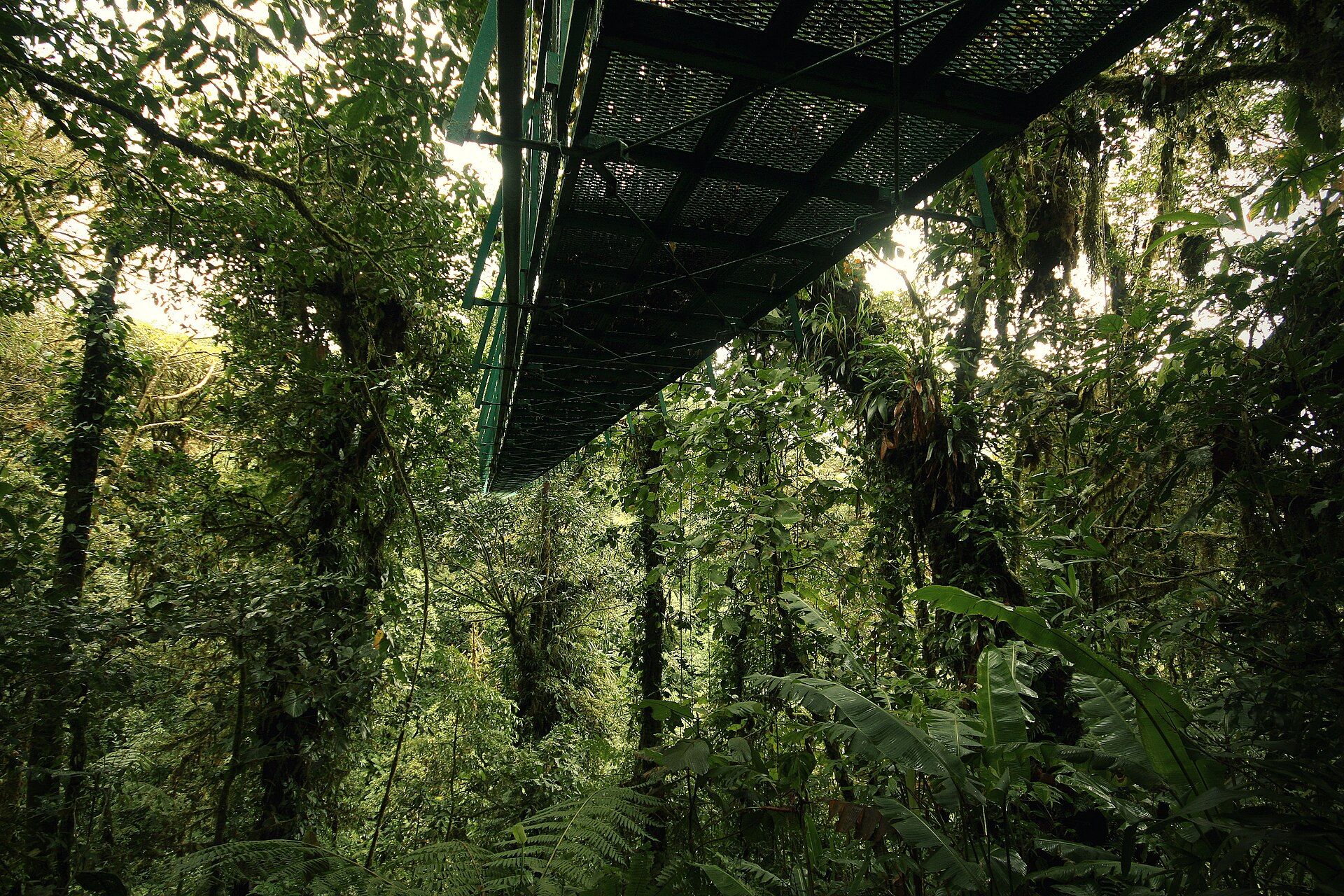
Image: File:Hanging bridge, Costa Rica.jpg by Alex, via Wikimedia Commons (https://commons.wikimedia.org/wiki/File:Hanging_bridge,_Costa_Rica.jpg). License: CC BY 2.0 (https://creativecommons.org/licenses/by/2.0/). Cropped for display.
The mist reached me before the forest did. On the way toward Selvatura, it moved across the road in soft folds, hiding one cluster of trees and revealing another. I had planned a day above and among the cloud forest canopy, but I began with no clear view of its top. That felt appropriate. Monteverde had never promised to show everything at once. I zipped my jacket, stepped into the cool air, and looked up at leaves fading into pale gray. The day would be about changing perspective, and the first change was learning to welcome a view that was partly concealed.
Selvatura offered several ways to meet the forest, including suspended walkways and a canopy tour. I chose to begin on foot. The thought of crossing a bridge above the vegetation made me excited, but I wanted to arrive gradually, hearing the forest from ground level first. The path drew me between mossy trunks and layered leaves. Water clung to surfaces without falling as rain. I listened for birds and heard a call I could not identify. The air felt cooler than the coast I had imagined earlier in my journey, and the difference made me slow down almost immediately.
At the first bridge, I paused before stepping on. It was not fear exactly, though I felt the height in my stomach. The walkway gave me a safe route through a space that normally belongs to branches and birds. I put a hand near the rail, checked that I was following the posted instructions, and moved forward. With every step, the angle of the forest changed. Leaves I would usually see from below came closer to eye level. The ground dropped away, but the green rose around me. I stopped in the middle to let that unusual balance settle.
The bridge moved gently beneath my feet, just enough to remind me that this was a suspended path. I focused on my breathing and looked outward. Mist drifted between trees, opening a view and closing it again. The far side of the bridge seemed to appear only when I stopped trying to see it all at once. I had expected the canopy to feel like a single broad roof. Instead, it was a series of layers and gaps, with vines, branches, and small openings in the light. I felt as though I had walked into the middle of a conversation already underway.
The official Selvatura site describes both hanging bridges and a zipline canopy tour. Those are distinct experiences, and I liked the contrast they offered. A bridge asks me to move slowly enough to inspect a leaf. A zipline would ask me to trust equipment, guides, and my own willingness to let the forest move past. I kept the second possibility for later. For now, my walking pace gave me time to notice how water gathered on moss and how the mist changed the color of distant trees. There was no need to decide which activity was “best.” They answered different curiosities.
On solid ground between bridges, the forest seemed denser. I noticed how the change of height changed what I heard. Above, wind had been more noticeable. Below, small sounds in the vegetation came forward. I did not try to turn every sound into a wildlife claim. Cloud forests are full of life, yet sightings depend on chance and attention. I was content to see evidence of moisture everywhere: droplets along a leaf edge, damp bark, a pale veil in the gaps between trunks. The mist was not an inconvenience that hid the view. It was part of what made this forest itself.
At another bridge, I allowed a group behind me to pass before I stopped to look. Shared paths require courtesy, especially when everyone wants a photograph. I moved to an appropriate spot and let the scene unfold. A beam of light reached through the cloud and briefly brightened a branch. Then it vanished, leaving the greens deeper. I could have spent the whole day trying to capture that exact change. Instead, I took one image and put the camera away. The moment was more interesting in motion than it would be frozen in my phone.
I thought about how easily “canopy” becomes shorthand for adventure. It can be thrilling, but it is also habitat. My position on a constructed walkway was a privilege made possible by planning and maintenance. I stayed on the route and avoided reaching for anything growing nearby. A leaf close to my hand still belonged to the tree. The forest did not become a playground simply because I was high above the ground. The height made me more aware of my place within it, not less.
By midday I was ready to consider the zipline. I listened carefully to the staff instructions and checked what the activity required. I would not advise anyone to decide from a travel story alone whether a canopy tour suited their health or comfort with heights. A reputable operator's current requirements and safety briefing mattered more than my excitement. In this imagined day, I chose to go ahead because the guidance fit me, and the anticipation gave the afternoon a new energy. I felt nervous in the honest, enjoyable way that comes before trying something unfamiliar.
The harness and helmet changed how I carried myself. I had to pay attention to clips, position, and the guide's signals. The details of equipment were not mine to improvise or teach in an article; I followed the trained staff. When my turn came, I looked toward the line disappearing into green and took a breath. A moment later the forest moved around me faster than it had on the bridges. Wind reached my face. The distance between platforms felt both shorter and larger than I expected. I arrived smiling, aware that my memory would keep the sensation more clearly than any photograph.
Between lines, I returned to stillness. The platforms made natural pauses in the sequence, though I treated them as working spaces rather than viewpoints to occupy without direction. I watched mist slide behind a stand of trees and heard someone ahead laugh with relief. The canopy tour did not replace the morning walk. It made me appreciate it more. After moving quickly through a corridor of green, I wanted another chance to stand quietly and see the individual branches that had become a blur. The two rhythms belonged to the same day.
I was careful not to describe the experience as flight in a way that erased the people and systems supporting it. Lines, platforms, trained guides, inspection, and weather decisions all mattered. The exhilaration was real in the scene, but it rested on following directions. I would be uneasy with any story that suggested a visitor could ignore those details and simply launch themselves into the forest. The better account held both truths: a thrilling change of perspective and the ordinary discipline that makes it possible.
After the activity, I took a quiet walk where permitted and let my senses return to ground level. My feet found the path again. The air smelled of wet leaves and earth. I could hear my own steps. The day had given me a view from above, motion through the canopy, and now the close detail of the understory. None was a complete picture of Monteverde. Together they made the forest feel more dimensional. I understood why a place can reward both an adventurous traveler and someone who simply wants to walk and listen.
The mist thickened as afternoon advanced. Instead of being disappointed, I watched how it simplified the scene. Distant branches disappeared, and the nearest leaves grew more distinct. A bright flower or a dark trunk became an anchor for my eye. Cloud forest weather is not stage lighting that stays fixed for a visitor. It has its own movements and demands. I was grateful that my plan had left room for them. Had I measured the day only by clear views, I would have missed the beauty of the forest revealing itself in fragments.
I thought about the distinction between Selvatura and the Monteverde Cloud Forest Biological Reserve. Both belong to the broader region, but they are different places with separate access and management. It is easy for travel writing to blur them into one generic “Monteverde canopy” attraction. I wanted to be precise. My story centered on the operator's walkways and canopy tour, not an imagined passage through every protected forest in the area. Precision gave the narrative more texture. It placed the sensations of my day somewhere real instead of in a collage of regional imagery.
On the way out, I looked back once at the bridge I had crossed first. From the ground it seemed quieter, almost hidden in the trees. I remembered how large it had felt when I stood in its middle. Perspective had changed twice: first by climbing to the canopy, then by returning below it. I liked that neither view canceled the other. The forest was not more authentic from one height. It was more complex than any single position could show. The day had let me feel that complexity through my feet, my breath, and a few carefully chosen moments of speed.
I would tell a friend to decide what kind of day they want before booking. If the goal is slow observation, the walkways deserve unhurried time. If they want the rush of a canopy tour, they should read the operator's current requirements and arrive ready to follow the staff's guidance. There is room for both, but no need to cram them in without pauses. Bring layers for changing mountain weather and let mist count as part of the experience. The forest's mood can shift while you are on a bridge, and that shift may be the scene you remember most.
That evening, the feeling of the first bridge returned to me. I could remember a slight movement underfoot and the moment when a curtain of mist opened just enough to show another depth of green. The zipline had given me exhilaration; the bridge had given me a way to linger. I was glad for both. Monteverde had met me without offering a permanent clear view, and I left with a richer picture because of it: not a panorama to possess, but a series of changing glimpses of a forest alive beyond my visit.
I checked my notes before sleeping and found that the most repeated word was “again.” Look again at the moss after the mist shifts. Listen again when the wind eases. Pause again on the next solid stretch of path. It was a useful reminder for the rest of my trip. New experiences do not always require a new destination; sometimes they begin when I give a familiar view another minute. Selvatura had offered a striking route through the cloud forest, but its most lasting gift was this habit of returning my attention to what was already before me. I hoped I would carry it to every place that followed.
Editorial note: This first-person story is an illustrative narrative composed from research. It does not describe an actual visit by a Costa Rica Travel Professionals staff member or customer. Confirm current Selvatura activities, eligibility, weather policies, and safety instructions with the operator.
A world of wonder awaits
Plan your Costa Rica adventure
Tell our destination concierges what you want from Costa Rica, and we will help shape the journey.