Santa Teresa: Slow Days on the Nicoya Peninsula | Costa Rica Travel Professionals
Travel Stories
Santa Teresa: Slow Days on the Nicoya Peninsula
The first thing I did in Santa Teresa was put my bag down and stop looking at the time. The road into town had demanded my attention: changes in light, the movement of other travelers, glimpses of sea between buildings and trees.
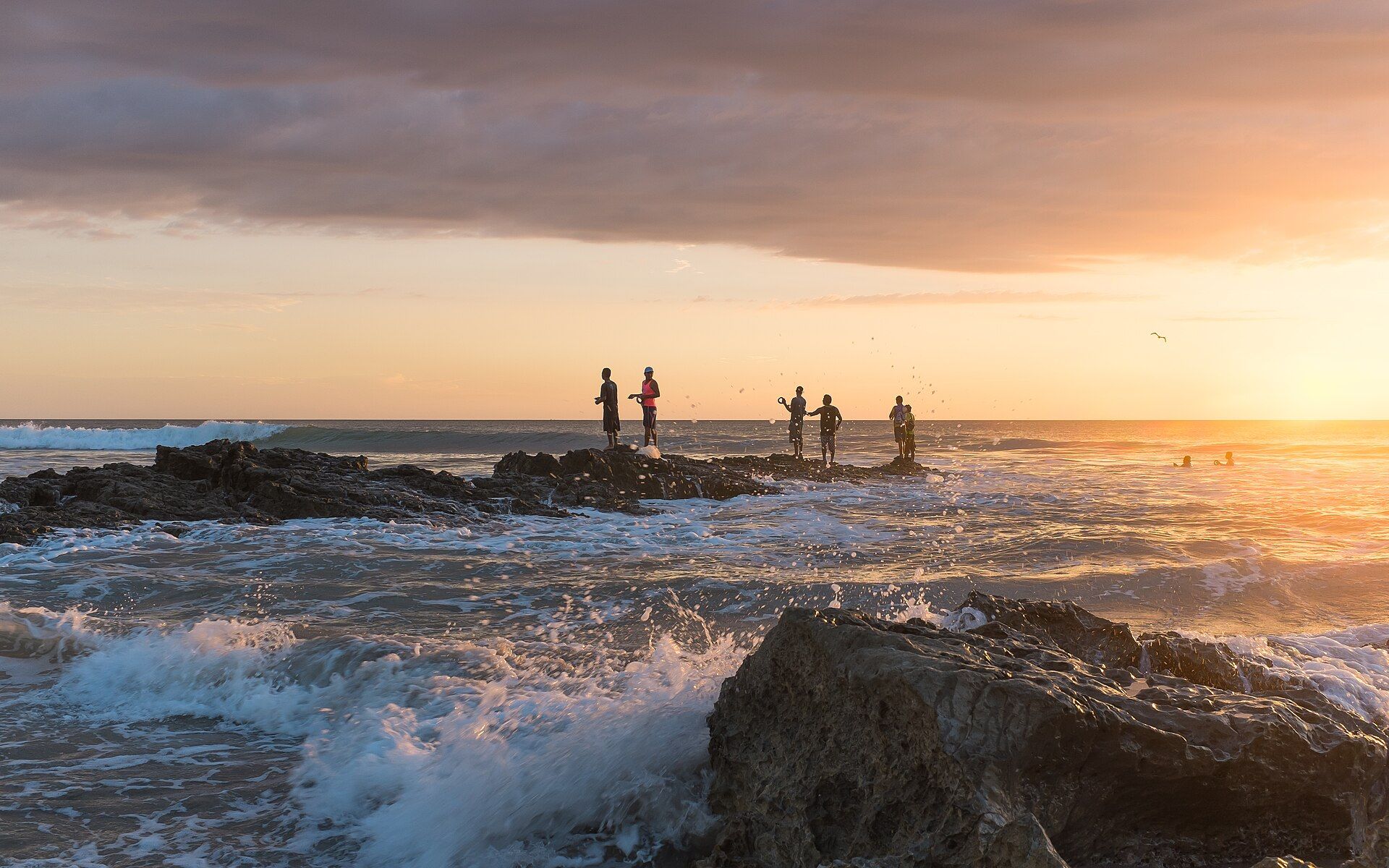
Image: File:Fishermen at Sunset, Playa Santa Teresa, Costa Rica.jpg by Christopher Crouzet, via Wikimedia Commons (https://commons.wikimedia.org/wiki/File:Fishermen_at_Sunset,_Playa_Santa_Teresa,_Costa_Rica.jpg). License: CC BY-SA 4.0 (https://creativecommons.org/licenses/by-sa/4.0/). Cropped for display.
The first thing I did in Santa Teresa was put my bag down and stop looking at the time. The road into town had demanded my attention: changes in light, the movement of other travelers, glimpses of sea between buildings and trees. When I finally reached the room, I expected to feel eager to get somewhere else. Instead I stood on the threshold for a moment and listened. A fan turned overhead. Outside, the afternoon went on without asking me to join it. I had come to the Nicoya Peninsula with an itinerary full of possible beach hours, meals, walks and sunsets. What I needed first was permission to have an ordinary hour. I opened a window, drank water, and let the journey end before starting the next part of the day.
Later, I walked toward the beach carrying sandals in one hand. There was no grand arrival, only a gradual widening of the view. The Pacific appeared as a band of changing color, and the sound of it became clearer with each step. Santa Teresa is often described through images of surfing and sunsets, but standing there I noticed something less easy to sell: the space between one breaking wave and the next. I had spent too much of the previous week filling those spaces with plans. Now I watched the water withdraw and reveal a darker strip of sand. The shoreline was a place to be, not an item to complete. I decided that would be the shape of this visit.
Learning the day's pace
I began the next morning early, before the light had turned hard. I took a short walk with no destination beyond a stretch of coast that looked inviting from where I stood. I paid attention to the ground because an unfamiliar beach deserves that courtesy. Sand shifted under my feet. Pieces of driftwood interrupted the smooth line left by the tide. Farther out, the water had a force I could see even from shore. I did not need to enter it to feel close to it. At one point I sat and watched a few waves arrive at different angles, each apparently about to repeat the last and each finding a slightly different way to fold. This was not dramatic travel. It was a chance to notice how much a single place can change in ten minutes.
The beach was not mine to imagine as empty. Other people had come for their own reasons: exercise, a conversation, a look at the sea before work or perhaps the same kind of quiet I wanted. I made room for them in my picture of the morning. Too many travel stories make a village disappear so that a visitor can feel alone in paradise. Santa Teresa felt more interesting when I remembered that it was also a place where daily life continued. A person carrying groceries and someone with a surfboard might pass one another on the same road. A beach can be beautiful and still belong to a community. That thought changed the way I walked back through town. I looked for ways to be a considerate guest rather than a collector of scenery.
Over breakfast I resisted the temptation to book every open hour. There were tempting possibilities in every direction, and I could have made a busy day look impressive on paper. But I had come with one clear wish: to feel the peninsula's rhythm instead of rushing across it. I made one decision at a time. After eating, I would walk again. Later I could ask about a lesson or find a shaded place to read. If the weather changed, I would let the plan change with it. A day without a rigid schedule still requires judgment, especially near the ocean, but it leaves room for attention. I wanted enough structure to be comfortable and enough freedom to be surprised by what was already there.
The shore from a different distance
I have always admired surfers from land. In Santa Teresa, watching them made me think about patience more than speed. From a distance a wave ride can look like one effortless gesture. The waiting before it is longer and less photogenic. People watched the horizon, moved into position, missed chances, and tried again. I could not read conditions from shore well enough to decide what would be safe for me. If I chose a lesson, I would want a qualified local instructor who knew the day and the right place for a beginner. For now, I stayed on dry sand and let observation be its own experience. I had arrived wanting the place to teach me how to slow down; the surfers' attention to timing offered an unexpected version of that lesson.
Farther along, the beach changed character. The sound of the village diminished, and the sea seemed louder. I kept my walk modest, aware that sun, heat, and a long return can turn an easy idea into a tiring one. I carried water and stopped in shade when I found it. The pause was not a failure to make progress. It allowed me to see how the shore was stitched to the land behind it: a line of vegetation, patches of shadow, and the occasional opening where a path met the sand. I had no need to name every plant or invent a wildlife encounter. The coast was enough as itself. The story I wanted to take home was about the feeling of moving through it carefully.
At midday I returned to town. The heat invited a slower pace, so I accepted it. I chose a small place to eat, sat where I could feel the air move, and let lunch last longer than it would have at home. The details of a meal matter in a travel memory even when there is no famous dish to recommend: the coolness of a glass in my hand, the brief relief of shade, the sound of talk passing by without asking me to answer. I thought about how easily I might have missed that hour if I had treated Santa Teresa as a base for a checklist. A village reveals itself through these intervals. Travel becomes more personal when I stop treating rest as time stolen from the destination.
A road that keeps going
That afternoon I went out again, this time away from the water. I wanted to see the ordinary road that had delivered me to the beach. It held a changing mixture of places to stay, eat and gather, and of people moving through a day that had no obligation to match mine. I walked with care where vehicles and pedestrians shared space. The longer I stayed, the less I wanted to call the town simply laid-back. That word can hide the work that makes a visitor's easy day possible. Someone prepares food, keeps rooms ready, teaches lessons, and makes decisions about a changing coast. I could appreciate the relaxed feeling I had come for while remembering that it is not the whole account of local life.
Near a shop window I caught a reflection of myself looking unusually unhurried. It made me laugh. I had brought a book I had been meaning to finish and a notebook full of places to see; so far the notebook had been less useful. I wrote a few lines anyway, not to record a perfect itinerary, but to capture the small changes in my attention. Morning light on wet sand. The difference between hearing waves from a room and standing before them. The way a route seemed shorter when I was no longer trying to arrive quickly. These observations would not help anyone reproduce my day exactly. They were proof that I had actually been present inside it.
I considered arranging an excursion for the following day. The peninsula offers more than one kind of landscape, and there is value in going beyond a single beach. But I did not want to use Santa Teresa only as a launch point. I asked myself whether another journey would deepen this one or merely interrupt it. The answer could be different for another traveler, or on another morning. I liked that my visit allowed for either choice. A thoughtful trip does not have to be sparse; it has to fit the people taking it. For me, on this occasion, one more unhurried day in the same place seemed like a rare gift.
The evening's long arrival
Before sunset I returned to the shore. The light had softened, and the same stretch of sand looked new. I found a place to sit well back from the water and waited. There is a kind of impatience that can survive even in a beautiful setting: the wish for the best color, the perfect photograph, the exact moment that proves the trip was worth making. I felt it for a while. Then a cloud moved across the sun, and the scene became subtler than the image I had imagined. I put the camera away. The sky did not need to perform for me. I watched its color change slowly over the water and felt the temperature ease. The experience became better as soon as I stopped judging it against an expectation.
A few people lingered nearby, each at a comfortable distance. I could hear conversation without making out words. The tide continued its work while the last light touched the edges of the waves. I thought of the people who return to this coast in different seasons and conditions, seeing variations I would never know from a short visit. That is one of travel's honest limits. I was not becoming an expert on Santa Teresa in two days. I was receiving a brief introduction. The humility of that thought made the evening feel warmer. I did not need to claim the place or explain it completely to appreciate what it had given me.
Back in my room, the first day's silence felt familiar. I rinsed sand from my feet and realized how little I had done by the standards of a crowded itinerary. I had walked, eaten, rested, watched the sea and walked again. Yet the day felt full. Every part had connected to the next without a schedule forcing the connection. I slept with the window closed against the night air and the memory of waves still close enough to hear in my mind. The next morning I would decide what to do next. For once, that uncertainty felt like part of the pleasure rather than a problem to solve.
One more morning
The next morning began with a sky that did not promise a postcard. It was pale and changeable, with light moving in and out behind cloud. I went to the beach anyway. Weather is part of a place, and I had not come only for its most photogenic version. The shore smelled different after the night. The sand was marked by small changes I could not explain and did not need to. I walked at the water's edge, leaving enough room for the sea's unpredictable reach, and watched the horizon become clearer. Nothing remarkable happened. That became the remarkable thing: I no longer required an event to justify being there.
For a while I sat and planned how I might describe the trip to a friend. I would tell them that Santa Teresa is on Costa Rica's Nicoya Peninsula and that the Pacific coast made it easy for me to build a day around light and water. I would also tell them what an article cannot guarantee. Sea conditions change. A lesson or swim should be chosen with current local advice. The experience of a village depends on the respect a visitor brings to it. The perfect sunset is not an appointment. Those caveats are not a drain on inspiration; they make room for a real place to exist beyond my imagination. I would rather invite a friend into that place than sell them a fixed scene.
On my final walk through town, I noticed the practical details I had barely registered on arrival. A route that had seemed long now had recognizable turns. I knew where the shade fell in the afternoon and where I had stopped for water. Familiarity in travel can be very small, but it changes the feeling of departure. I did not feel I had exhausted Santa Teresa. I felt I had learned how I might return: with fewer demands on the day, a willingness to ask local questions, and enough time to let the shoreline look different from morning to evening. There are trips that leave me with a list of accomplishments. This one left me with a way of paying attention.
When it was time to go, I took one final look toward the sea. A wave broke, and another followed it. I understood why visitors talk about the beauty of this peninsula, yet beauty alone was not what I wanted to carry away. I wanted the memory of making space for a place instead of trying to fit it into a prewritten story. Santa Teresa had offered a slow day, then another, and in those days I had felt more present than I expected. The coast would go on without me. I could leave it with gratitude and with the quiet hope that my next journey would allow the same generous margin for the unexpected.
Editorial note: This first-person story is an illustrative, researched narrative created for travel inspiration. It describes an imagined trip, not an actual visit by a Costa Rica Travel Professionals staff member or customer. Current local conditions and ocean safety guidance should be checked when planning.
A world of wonder awaits
Plan your Costa Rica adventure
Tell our destination concierges what you want from Costa Rica, and we will help shape the journey.