Rincón de la Vieja: A Geothermal Landscape | Costa Rica Travel Professionals
Travel Stories
Rincón de la Vieja: A Geothermal Landscape
I had come to Guanacaste expecting broad light and open horizons. The road toward Rincón de la Vieja gave me both, then gradually drew me into a landscape that seemed to hold its breath. From a distance, the mountain looked settle
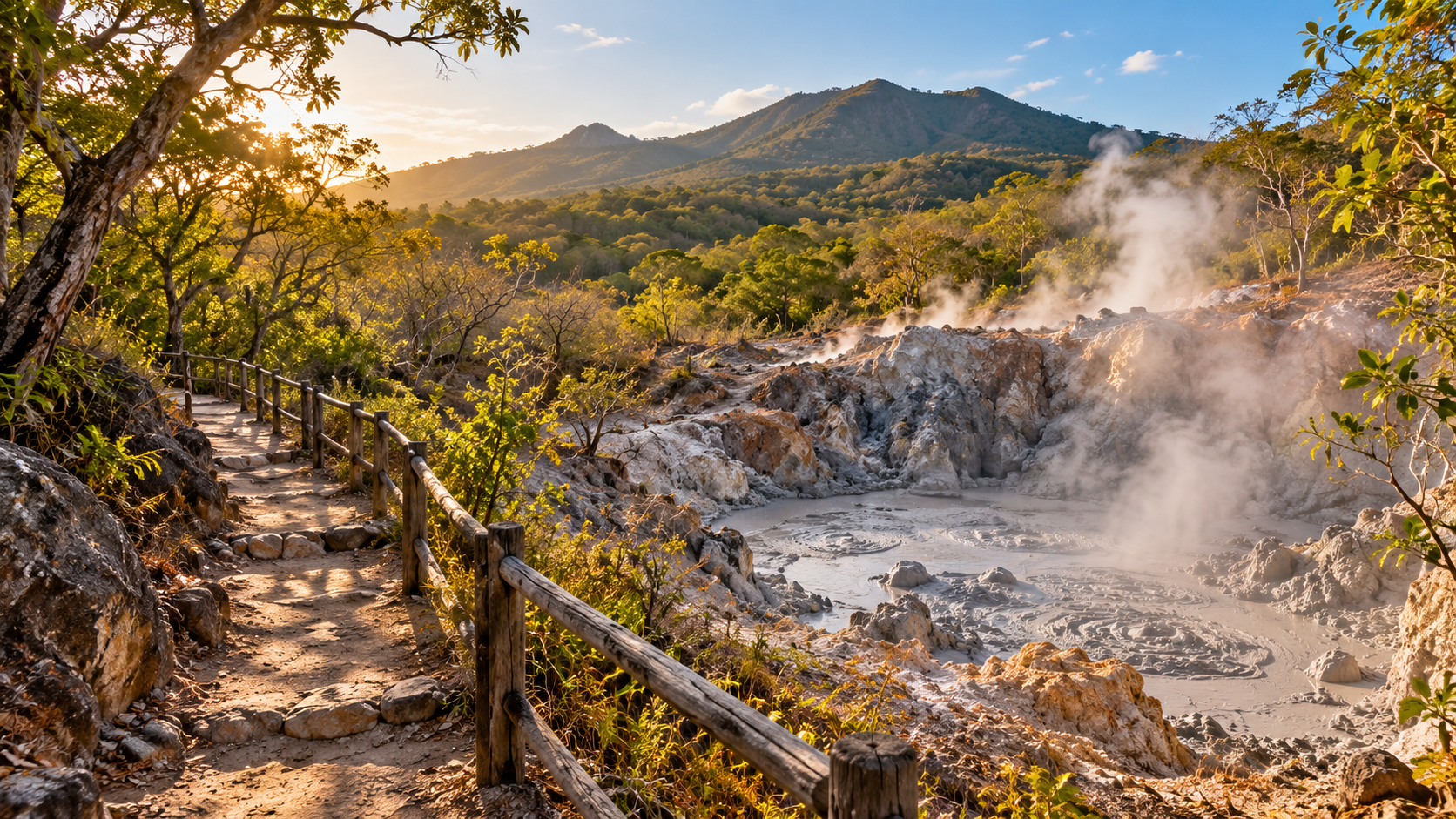
Illustrative AI-generated image created for this story; it is not a documentary photograph.
I had come to Guanacaste expecting broad light and open horizons. The road toward Rincón de la Vieja gave me both, then gradually drew me into a landscape that seemed to hold its breath. From a distance, the mountain looked settled against the sky. Up close, the ground told another story. This was an active volcanic place, and the Las Pailas sector promised a way to encounter some of its geothermal features from established paths. I had read enough to know that there would be steam and mud, but those were still abstract words. As I stepped onto the trail, I wondered what it would feel like to be near earth that was visibly at work.
The first part of the walk surprised me with its restraint. I had imagined a constant theater of heat, yet the path began with the ordinary pleasures of moving through trees: shade, shifting light, the dry sound of leaves underfoot in some stretches. A branch moved above me. I looked up and saw only a layered canopy, each leaf edged by the morning sun. The volcano was present, but it did not announce itself at every turn. I liked that. It made me pay attention to the less dramatic details instead of hurrying from one steaming feature to another.
Soon the air changed. A mineral sharpness reached me before I could see its source, and a faint suggestion of steam rose beyond the vegetation. I stayed on the marked route, aware that a geothermal area is not a place to improvise shortcuts. The earth around the feature looked different, its colors and textures unlike the ordinary forest floor. I did not need to be close to feel the contrast. There was a path for visitors and, just beyond it, evidence that the mountain worked by rules of its own. Respecting that boundary made the moment clearer, not smaller.
At a bubbling mud feature, I stopped longer than I expected. The movement was almost comic at first: a swell, a soft collapse, another swell. Then I began to hear the irregular rhythm beneath it. The mud did not move like water, and the sound was too low and intimate for the grand language of volcanic spectacle. I watched its surface rise and settle, thinking about heat making itself visible through something as familiar as earth and water. It was a reminder that the most astonishing sights are not always the biggest. Sometimes they fit within a small frame and ask you to look closely.
The trail carried me back into vegetation, where birds and wind reclaimed the soundtrack. Rincón de la Vieja is not only a volcanic exhibit. The protected area includes different environments and paths, and the official park information describes both Las Pailas and Santa María sectors. I was following one possible thread through a larger place. That awareness kept me from writing a single walk into the whole story of the mountain. Elsewhere, routes and conditions would offer different views; some might be inaccessible at a given time. My day was a narrow window, and it felt richer for admitting its limits.
I thought about how quickly a traveler can turn a place into a collection of highlights. A patch of steam: photograph. Mud pot: photograph. A possible waterfall elsewhere: next stop. The trail resisted that rhythm. Between geothermal features, the forest required its own attention. I watched sunlight move down a trunk and noticed the sharp line between shade and heat where the path opened. My water bottle felt pleasantly cool against my hand. The pleasure of the walk came partly from these transitions, from the way a living landscape interrupted the mental list I had carried in.
Another area held steam that seemed to appear and vanish as the breeze shifted. For a moment it lifted like breath from the ground; then it flattened and drifted through the light. I could smell the volcanic character of the place and feel the warmth of the day, but I did not invent a dangerous drama around it. The real drama was enough: heat below, forest above, visitors moving carefully through a narrow corridor of safe access. I imagined the enormous processes beneath my feet, then returned my attention to the practical next step, placing one foot after another on the trail.
At a shaded pause, I listened to the landscape's competing tempos. Leaves moved quickly in the wind. The mud bubbled on its own irregular schedule. My breathing slowed after the walk. Those rhythms made the place feel less like a static view and more like a conversation I could enter only briefly. I could not fully explain the geology from a single morning, nor could I claim to have discovered a secret. I could listen, observe, and let the contrast between forest and geothermal ground change the way I understood the word alive.
The name Rincón de la Vieja had been a label on my itinerary before I arrived. On the path, it became a sequence of sensations: dry brightness on an exposed stretch, the smell of damp earth under trees, the uncanny sight of steam where I expected ordinary ground. I found that the name stayed with me differently after I had moved through the place. It held both the mountain's scale and the small observations I made at walking height. Travel often works like that. A destination stops being an item once your body has learned its air, its light, and its pace.
I was grateful that the visit did not require me to pretend expertise. Official information can tell travelers which sector is open, which paths are available, and how to visit safely. Beyond that, curiosity is enough. I did not need to name every plant or interpret every geological feature on sight. If I wanted a deeper explanation, a qualified guide could add context. For this imagined walk, I let the questions remain questions: how long had that vent released steam, what shaped the colors around it, what would this path look like after rain? Unanswered questions were part of the appeal.
The wider Guanacaste landscape felt close even when the trail enclosed me. There were moments when the vegetation opened and the light became larger again. I could picture the road I had traveled in, the slopes beyond, and the other journeys someone might weave into this region. But I did not want to rush out of the park to make the day more complete. The volcano had already asked me to recalibrate. Its visible features belonged to systems moving on a scale far beyond a vacation. A few attentive hours were a reasonable way to begin, not a failure to cover everything.
I watched one last patch of mud rise and sink. At first glance, it resembled what I had seen earlier. Then I noticed its different rhythm, the way a small bubble formed along an edge rather than the center. The scene rewarded a second look. I wondered how many other places I had passed through after giving them only one. Perhaps that was the real gift of the geothermal trail: it made looking feel active. The mountain did not present a polished view and ask for admiration. It offered change, texture, and uncertainty, and asked me to stay with them.
On the return, the sun had moved, altering the route I thought I knew. A section of path that had felt cool earlier was now bright. The trees cast longer shadows. I heard a call from somewhere high above and waited, but I could not find the bird. The missed sighting did not trouble me. Wildlife is not a scheduled part of a park visit, and I had no wish to turn a living forest into a guarantee. The sounds, even without names, made the protected landscape feel inhabited beyond my own footsteps.
As I left, I felt a quiet contrast between the ordinary movement of the day and the forces that shaped what I had seen. People would return to their vehicles, find lunch, make plans for the afternoon. Beneath that familiar sequence, the mountain would continue its work. I liked carrying both scales at once. The walk had not made me feel small in a discouraging way. It had made me feel proportionate, a temporary guest allowed to witness a few expressions of a much older process.
I imagined telling a friend about the visit and realized I would start with the sound rather than the view. I would describe the irregular soft burst of bubbling mud, the pause before another bubble formed, and the way the forest resumed around it. A photograph might show color and shape, but it would not hold that rhythm. Nor would it show how cautiously I approached the marked viewing area or how the air changed before the steam appeared. The story lived in the spaces between the obvious sights.
For a future traveler, I would leave room in the plan for those spaces. Check the current official information for the right sector and open trails. Give the route time. Carry what the conditions call for, and keep to designated paths. Then let the mountain surprise you without expecting a particular performance. Rincón de la Vieja can offer striking geothermal scenes, but its deeper appeal is the way they sit within a larger protected landscape. Heat and shade, motion and stillness, open Guanacaste light and close forest detail all belong to the same day.
By the time I was back on the road, the mountain again looked calm from a distance. I knew that appearance was only one layer. I had seen mud shift and steam lift from the ground. More importantly, I had practiced meeting the place without reducing it to those moments alone. The memory that stayed was a walk with alternating textures, each one sharpening the next. I arrived expecting the dramatic. I left remembering a quieter form of wonder: the realization that a landscape can be both steady beneath the horizon and continuously changing underfoot.
The next day, I could imagine another beach, another forest, another route across Costa Rica. This place would remain distinct. It had a smell and a sound that no broad description of the country could absorb. It had also reminded me that careful travel is not timid travel. Following the path, honoring closures, and letting the site set the pace allowed me to be fully present. In the space between a bubbling mud pool and a stand of trees, the journey felt both adventurous and grounded. That was the Rincón de la Vieja I wanted to keep.
I returned in memory to the first stretch of quiet forest before the volcanic features appeared. At the time it had seemed like an introduction, something to pass through before the real subject began. Now I understood it as part of the subject. The shade had made the steam more startling; the birdsong had made the bubbling mud sound stranger. The landscape did not divide itself into attraction and background. It held both together. That realization followed me beyond the park, inviting me to ask what I might be calling background in the next place I visited and what I would discover if I gave it my full attention.
Editorial note: This is an illustrative first-person story, imagined from research to inspire travel. It does not describe a real visit by Costa Rica Travel Professionals staff or a customer. Check current SINAC access and safety guidance before planning. The accompanying image is AI-generated and illustrative.
A world of wonder awaits
Plan your Costa Rica adventure
Tell our destination concierges what you want from Costa Rica, and we will help shape the journey.