Poás Volcano and a Central Valley Morning | Costa Rica Travel Professionals
Travel Stories
Poás Volcano and a Central Valley Morning
The morning began in the Central Valley with a sky that refused to make promises. From below, the hills were visible in layers, each one a little paler than the last. Higher up, cloud seemed to be waiting. I had set out toward Poá
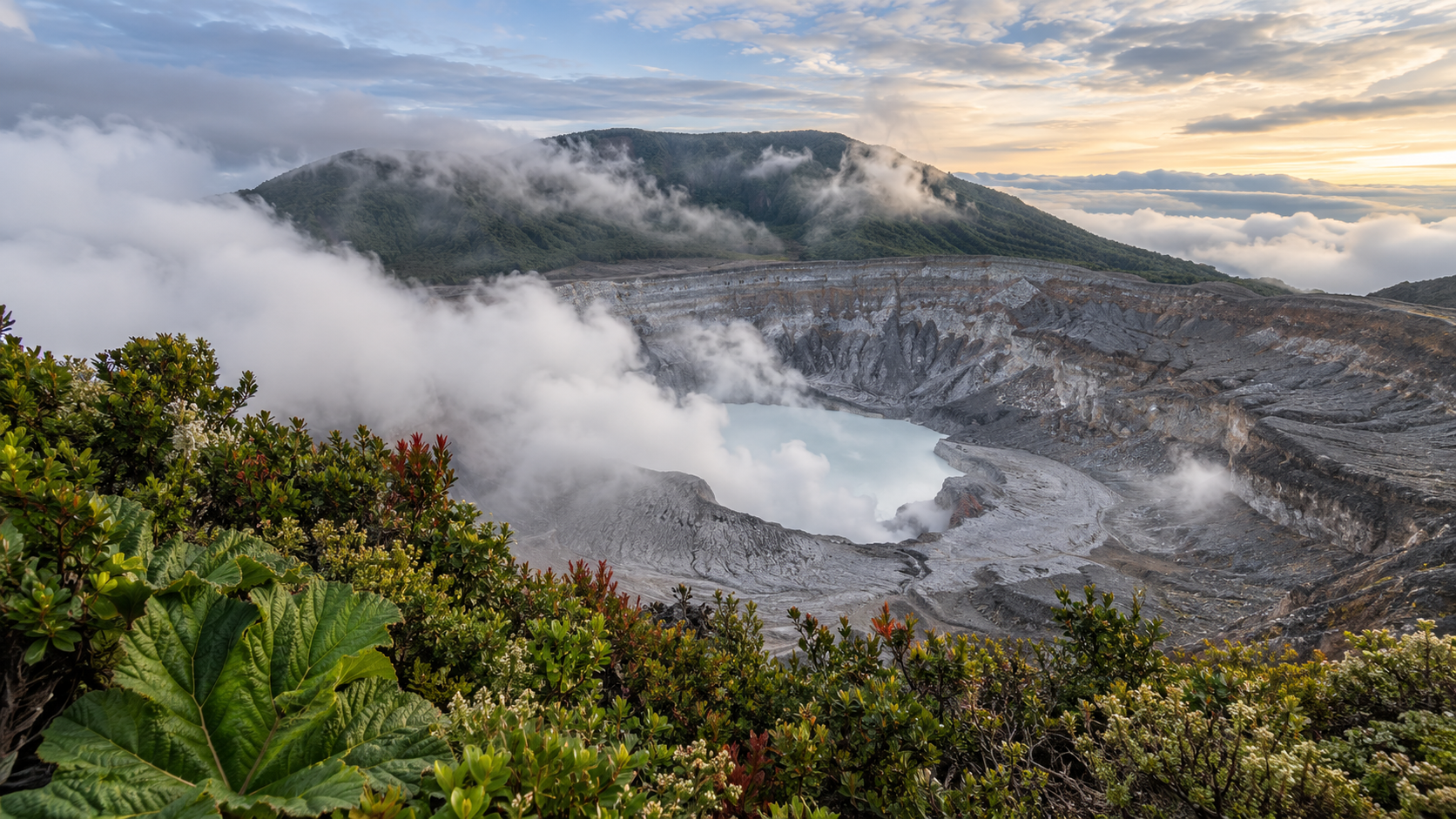
Illustrative AI-generated image created for this story; it is not a documentary photograph.
The morning began in the Central Valley with a sky that refused to make promises. From below, the hills were visible in layers, each one a little paler than the last. Higher up, cloud seemed to be waiting. I had set out toward Poás because I wanted to see the volcano's crater, but I already suspected that the journey might be as much about weather as geology. On an active volcano, a clear view is never something a traveler can order. There are days when the mountain keeps its distance behind cloud, and days when official conditions change what can be visited. I carried that uncertainty with me as the road climbed. It made the morning feel more awake.
The valley gradually loosened its hold. Buildings gave way to slopes, and the air coming through a partly opened window felt cooler. I watched the landscape shift without trying to attach a fact to every field. There was a quiet satisfaction in seeing how quickly the character of the day could change: the bustle of a populated valley behind us, a mountain landscape ahead. I had imagined a volcano as an isolated spectacle, something to stand before and photograph. The approach suggested otherwise. Poás belonged to a wider highland world, and the road was teaching me to notice the transition.
At the park, I paid attention first to the instructions. A protected volcanic area asks for a different kind of respect than an ordinary viewpoint. The active landscape is monitored; access, safety measures, and routes can change. I did not want to treat a warning as an inconvenience that interrupted the adventure. It was part of understanding where I was. Once I had followed the current guidance, I could give my attention to the scene rather than wondering whether I had overlooked something important. The possibility of seeing the crater remained exciting, but care was the condition that made the encounter possible.
The walk toward the viewpoint felt strangely quiet. The mountain was not silent; there were footsteps, voices, wind, and the faint movement of vegetation. Yet the ordinary sounds seemed to leave more room around them. I sensed the scale of the place before I saw it. A bend in the route, a thinning of trees, and then an openness that felt less like the end of a path than the edge of another world. Cloud moved across the view. For a moment I could see only layers of gray, and I felt my old impatience rise. I had come all this way. Then I caught myself. The cloud was not obscuring the mountain; it was part of the mountain's morning.
When the view opened, even briefly, I understood why the crater has such a hold on the imagination. Its broad form was unlike the neat cone I had pictured when I heard the word volcano. The ground and the air seemed to meet in an immense unfinished sentence. I stayed back where visitors were meant to stand and let my eyes adjust to the depth of it. The contrast between the crater's raw interior and the surrounding highlands was startling. One scene spoke of heat, change, and time beyond any human itinerary. The other held the softer greens of life around it. Both belonged to Poás.
I had read that the park includes a main crater and the Botos lagoon, a rain-fed feature in the highland landscape. I did not assume every trail or viewpoint would be available on the day of an actual visit. In this imagined morning, the knowledge simply changed the way I looked at the terrain. The volcano was not one image but a collection of geological and ecological stories. I could stand at one viewpoint and still be aware that the mountain extended beyond my sight. That thought made the brief visible moments feel less like a missed opportunity and more like a glimpse into something larger.
Cloud returned and softened the rim. I watched other visitors lean forward, then relax, waiting as I was. There was a shared quality to the uncertainty. No one could make the wind move faster or instruct the sky to clear. The mountain set the terms. I found the waiting unexpectedly pleasant once I stopped measuring it against an imagined perfect photograph. A drifting veil of cloud showed the crater in pieces, and each piece seemed to have its own shape. I was not studying a fixed object in a museum. I was meeting a changing place.
I thought about the long history of volcanic activity here, but I resisted turning it into a dramatic claim about what might happen next. The facts are compelling without embellishment. Poás is active; its main crater and the acidic environment around it are real. That is enough reason to take official guidance seriously and enough reason to feel awe at a safe distance. Travel writing often tries to heighten a scene by making it sound more dangerous or more accessible than it is. I wanted a quieter honesty. The power of the place was visible in the land itself, in the way a cloud could reveal and conceal it in a single breath.
On the way back from the viewpoint, I noticed details I had overlooked while moving toward it. The curve of a branch. The weight of moisture on leaves. A small change in light as the cloud lifted above the path. The highland forest framed the volcanic landscape but did not exist merely to decorate it. It was an environment with its own patterns, shaped in part by altitude and the mountain's conditions. I took my time. The impulse to hurry toward the next stop felt oddly out of place after standing before a crater made over a timescale I could scarcely imagine.
The return toward the valley was a second journey through the same landscape. Descending, I saw how quickly the atmosphere changed again. A ridge that had been hidden now showed its outline; another disappeared. Fields appeared in patches of sunlight. I could feel the morning becoming warmer, and the layers of the valley seemed to draw closer. The experience was not a simple before-and-after, as though the mountain had delivered one impressive view and sent me back. It was a sequence of transitions: anticipation, uncertainty, revelation, cloud, and then a slower understanding that the entire route mattered.
I stopped for a pause rather than immediately adding another attraction to the day. With a warm cup between my hands, I tried to describe what I had seen without reaching for the easy words. Vast. Dramatic. Unforgettable. Each was true as an impression, but none captured the feeling of waiting while cloud moved over the crater. What stayed with me most was the way the landscape had changed my expectations. I had planned to see Poás, as though seeing were a single completed action. Instead, I had practiced looking, waiting, and accepting that some of the mountain would remain hidden.
That acceptance did not diminish the pleasure of the visible moments. It sharpened them. A sliver of crater wall appearing from the mist held my attention more completely than a guaranteed panorama might have. The wind did not arrange itself for my camera. The sky did not owe me a postcard. I had chosen to come to an active, elevated place, and the place answered in its own language. Even the cooler air became part of the memory, a reminder that Costa Rica can move from warm valley to high volcanic terrain within one travel day. The range of landscapes felt close enough to touch, yet distinct enough to reset my senses.
I imagined sharing the story later with someone planning a first Costa Rica trip. I would not promise a clear crater view, a particular trail, or an exact amount of time on site. Those details depend on current rules, conditions, and the day's weather. I would describe the value of leaving room around the visit: checking official information, arriving ready to follow instructions, and allowing the mountain to be unpredictable. The most satisfying itineraries make space for what cannot be controlled. A carefully arranged day can still contain surprise.
By early afternoon the valley had gathered its familiar sounds again. I could hear traffic, conversation, and the ordinary work of a place where people live. The crater already felt far away, though the cooler air remained in my memory. I liked the contrast. Costa Rica's Central Valley is not simply a gateway to somewhere else; it is part of the experience, a lived landscape beneath the volcanic heights. Looking back toward the hills, I thought about how many people go about their daily routines with that mountain in the wider geography of home. My brief visit was only one small perspective on it.
The image I carried away was not a perfectly clear crater. It was a moving edge of cloud opening just enough to reveal the scale beneath. That is the kind of moment I often miss when I travel too quickly. I want the full view, the completed plan, the picture I expected. Poás reminded me that attention can turn an uncertain morning into a richer one. I had stood safely where visitors were allowed, watched the weather make and unmake the scene, and come away with a sense of the mountain that was more personal than any checklist could have provided.
I also carried a renewed respect for the people who manage access to places like this. A volcanic landscape is beautiful because it is alive with processes beyond us, and that same reality makes current guidance essential. The visit belongs to the present tense. What was open yesterday may not be open tomorrow. The best way to honor both the place and the experience is to plan with that in mind, to stay flexible, and to let trained authorities set the boundaries. Within those boundaries there is still more than enough wonder.
When I pictured the morning again, I saw the road lifting out of the valley and felt the temperature change. I remembered the restraint of waiting, the first opening in the cloud, and the way the highland vegetation caught the light on the walk back. The crater was the reason I came, but the story became larger than the crater. It was about traveling into uncertainty without needing to erase it. It was about letting a mountain remain a mountain rather than insisting it perform. That felt like a useful lesson to carry into every other Costa Rica landscape I hoped to meet.
Later, I found myself looking differently at the clouds above the valley. Before Poás, I might have treated them as an obstacle to the day's plans. Now they seemed like evidence of motion and possibility. I could imagine the crater hidden beyond them, the highland plants collecting moisture, and another visitor waiting where I had waited. I did not know what view that person would receive. The thought made me smile. A landscape shared across countless journeys does not become repetitive, because no two mornings arrange the light and weather in the same way. My own version of Poás was simply one imagined encounter among many possible ones.
Editorial note: This is an illustrative first-person story, imagined from research to inspire travel. It does not describe a real visit by Costa Rica Travel Professionals staff or a customer. Check current park access, volcanic advisories, and weather before planning. The accompanying image is AI-generated and illustrative.
A world of wonder awaits
Plan your Costa Rica adventure
Tell our destination concierges what you want from Costa Rica, and we will help shape the journey.