Playa Grande and Las Baulas Conservation | Costa Rica Travel Professionals
Travel Stories
Playa Grande and Las Baulas Conservation
I arrived at Playa Grande with an expectation I had to let go of almost immediately. The name Las Baulas had made me think of leatherback turtles, and a part of me had imagined that a visit to the national marine park would unfold
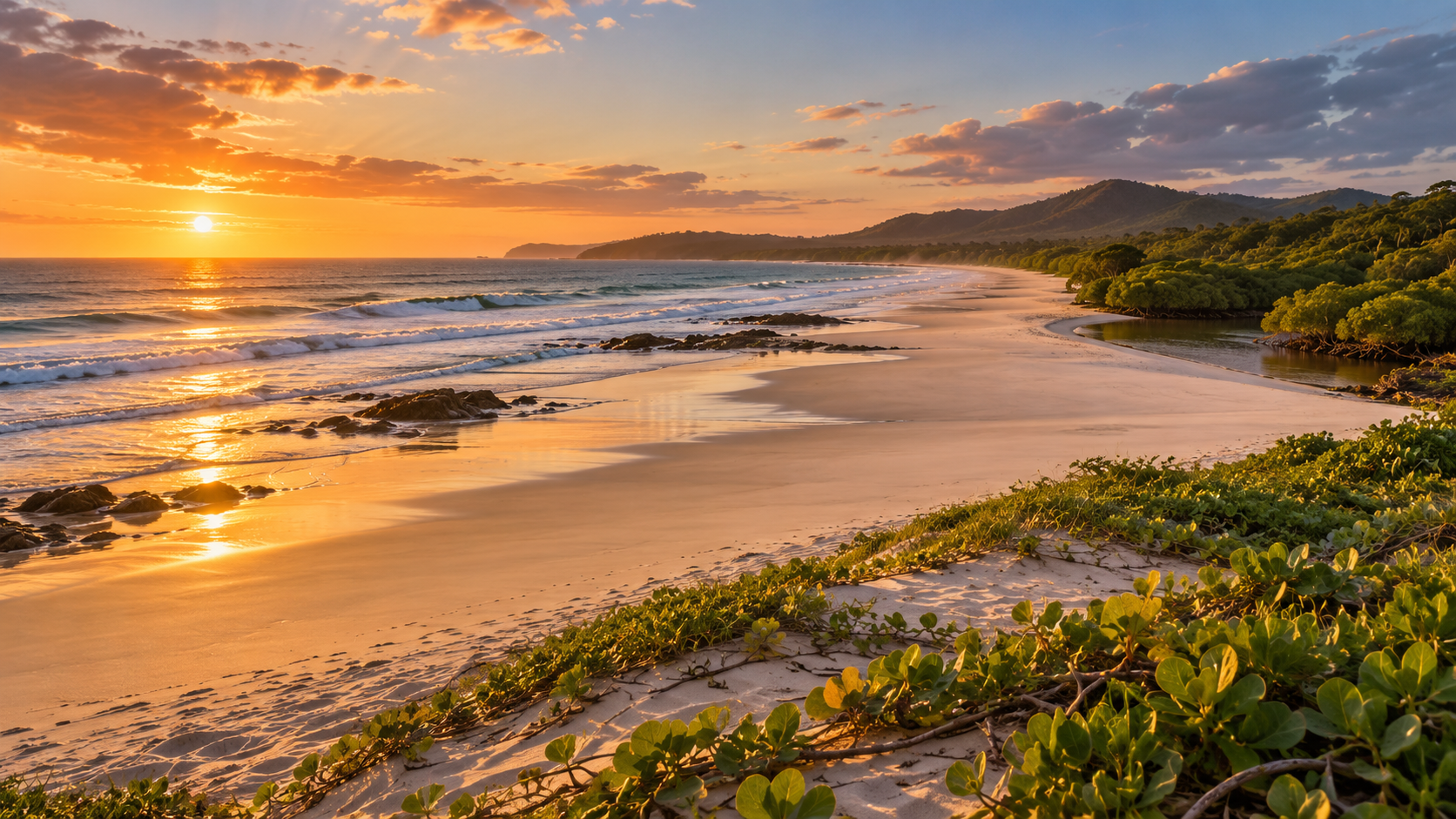
Illustrative AI-generated image created for this story; it is not a documentary photograph.
I arrived at Playa Grande with an expectation I had to let go of almost immediately. The name Las Baulas had made me think of leatherback turtles, and a part of me had imagined that a visit to the national marine park would unfold like a wildlife film. The beach itself told a quieter story. It stretched beneath a wide Guanacaste sky, waves drawing long white lines across the sand. The animals for which this protected coast is known might be nowhere in sight. The importance of the place did not depend on my seeing one.
That realization changed the morning. I had not come to collect a rare encounter; I had come to spend a day in a landscape shaped by the need to protect one. I left my sandals beside my bag and walked where the sand was firm, watching the water arrive in successive bands. The sunlight was strong. Inland, vegetation offered a dark green line against the openness of the shore. The park's name carried a specific conservation history, but the beach did not announce it with a sign at every step. It asked me to notice what a visitor's ordinary choices might mean in a place where wildlife uses the same ground.
I stopped before crossing a small scatter of driftwood. The impulse to rearrange it for a photograph passed quickly. I had no reason to improve the beach. It was not a set prepared for my pictures. I could follow the rules of the protected area, keep my distance from any animals, leave the sand as I found it, and let the day be shaped by what was actually present. This was a different kind of luxury from a guaranteed spectacle: the freedom to be in a living place without demanding that it perform.
A beach with another purpose
Leatherback sea turtles have made Las Baulas an internationally recognized conservation site. The Costa Rica Tourism Board describes nesting as the park's central attraction and also notes the importance of mangroves within the protected area. Yet the more I thought about the word attraction, the less comfortable I was with it. A nesting beach is not primarily an attraction for me. It is habitat. If I am fortunate enough to be there when a permitted, responsibly managed observation is possible, I should be a careful guest. If I am not, the protection still matters.
I imagined how easy it would be to tell a story that promised a turtle at a certain hour, or suggested that a visitor could simply wander onto the sand at night and watch. I would not tell that story. Wildlife sightings are never assured. Access and observation rules deserve to be checked with the park and authorized local guides, especially where nesting animals may be affected. The uncertainty does not diminish the experience; it puts my hopes in a more honest relationship with the animal's needs.
During my walk I watched the evidence of the sea's work instead. Wave after wave smoothed the edge of the beach. A shell appeared in shallow water, disappeared beneath foam, and returned farther along. The scene was simple enough that I could feel my attention sharpening. I thought of the nests that conservation teams work to protect and of how much care is required in places that look, at first, like open space. The beach was beautiful because it was not empty. It belonged to processes larger than the length of my stay.
The sun climbed, and I moved into the shade. From there I could hear the waves without seeing every break. I had brought a book but left it closed. The passage of light across the sand was more interesting than the pages. People came and went. I could not know their stories, and I did not need to invent them. The rhythm of the place was enough: footsteps, surf, a brief breeze, then the heat returning. This was a beach day, certainly, but one with an unusually clear reason to think beyond the beach day.
Where forest meets salt water
The protected landscape includes mangrove habitat as well as the nesting shore. I wanted to understand that second half of the park, so I pictured a guided exploration that would let me learn without disturbing the roots and channels. Mangroves can seem difficult to read from a distance. Their trunks and roots make a dense edge, and the water beneath them may appear still. But the tourism board's description points to the fish, crustaceans, mollusks, reptiles, amphibians, and birds that use these forests. A quiet channel is not an absence of life.
The transition from the open beach to the enclosed green would change the scale of the day. On the shore, I could see far and describe little: sky, surf, horizon. Near mangroves, I would see only a short distance and have far more to learn. A guide might point out differences among trees or explain how tidal water moves through the habitat. I would ask questions and resist the urge to turn every possible species into an expected sighting. The most useful thing a visitor can bring to a protected area is curiosity that does not become pressure.
I would especially want to learn how to look without pushing closer. A leaf moving at the edge of a channel might mean wind, or it might invite a patient second glance. Either way, I could remain where a guide asked me to remain. The forest's value did not rise or fall with my ability to identify every shape in it. I liked the thought of returning from a guided visit with better questions rather than a boastful species list. Which parts of the habitat change with the tide? What work helps keep the mangroves healthy? How can visitors support that work in ordinary, practical ways? Questions like these would give the day a longer life after I had left the coast.
I thought about the relationship between the two habitats. The beach and the mangrove could easily become separate stops on a hurried itinerary. Here they are neighboring parts of one coastal system. The tide that changes the shore also influences the channels. The park's conservation work makes more sense when I stop seeing isolated icons and start seeing connections. I did not need a scientific lecture to feel that shift. It was enough to move between an open, sunlit beach and the shade of roots and understand that both deserve space.
Back on the sand, a wave reached unexpectedly high and made me step aside. It was a small reminder that the shore is always in motion. Human plans and boundaries feel firm when drawn on a map; at the waterline, everything is negotiable. That movement made the park's protections feel more remarkable. They are an attempt to give vulnerable life a degree of safety in a place that never stands still.
Watching without taking
By afternoon I found a comfortable place to sit and let the heat settle around me. I had come with a question about whether a conservation-focused visit would feel less exciting than a wildlife encounter. The answer arrived quietly. The story of a nesting beach is not only the moment an animal appears. It is also the long work of keeping a shoreline usable for one. It is learning which activities must yield to that work. It is leaving the beach with nothing in my pocket that belonged there.
I would still love to see a leatherback one day, under rules that protect it. Wanting that experience does not make me a careless visitor. The difference lies in whether I treat the animal's presence as an entitlement. A carefully planned trip could ask the park what is currently allowed, work with authorized local expertise, and accept that an evening may end without a sighting. A respectful trip would make the beach's future more important than a photograph of my moment there.
The distinction mattered especially when I imagined telling this story later. I could speak vividly of the day without inventing a turtle crossing the sand. I could describe the big sky, the texture of the beach, and the way my thinking changed as I moved between surf and shade. I could describe the feeling of standing at the edge of habitat that supports an endangered species, knowing that absence from my view is not absence from the world. Those were real possibilities for emotional connection, even in an illustrative narrative.
I walked again when the light softened. My earlier footprints were gone or impossible to distinguish. The sea had worked over the sand, and other visitors had made their own paths. I liked the idea that a good visit might leave so little trace. In many travel stories, the traveler returns with proof: a close-up, a dramatic encounter, a list of places reached. Here my most meaningful souvenir would be a changed way of looking. I could love the landscape without asking it to give me more than a place to stand and learn.
The sand held my attention differently on this second walk. I noticed the slight slope toward the water and the shallow channels each retreating wave drew across it. I stopped treating the horizon as the only thing worth seeing. The beach's smallest forms were temporary, made and erased while I watched. That impermanence made the conservation story feel more urgent. What we protect is not a frozen picture of a coast. We protect the conditions that allow its living patterns to continue, even though no two visits will look alike. I could return years later and find another sky, another line of surf, and still recognize the value of giving wildlife room here.
As I left, I looked back at the line of surf. Playa Grande had been expansive enough to make me feel small in a welcome way. Las Baulas had made that feeling more precise. This was a coast where the needs of wildlife should set the terms of a visit. I could enjoy the sun, the sand, and the long sound of the Pacific while respecting those terms. That balance made the day richer than the imagined film I had brought with me.
For anyone designing a Guanacaste journey, I would make room here without turning the park into a promise. There are many ways to appreciate it: a daytime walk, time to learn about coastal habitats, a guided activity permitted under current rules, or simply an unhurried afternoon beside the water. The best plan would be informed by the park's current guidance and by the season, not by an old photograph or an expectation that nature follows an appointment. I would ask for help shaping that plan, then arrive ready to notice what the day actually offers.
At the end of the day, the beach looked ordinary in the most extraordinary sense. Waves came in. Light changed. Sand moved. Somewhere within the larger life of this coast was the reason a national park existed here. I did not need to witness every part of that life to value it. Playa Grande gave me the feeling I most wanted from travel: a wider sense of where I stood, and a reason to leave the place with more care than I had brought.
Editorial note: This first-person travel story is an illustrative, researched narrative created for inspiration. It does not describe an actual visit by a Costa Rica Travel Professionals staff member or customer. The accompanying image is AI-generated and illustrative.
A world of wonder awaits
Plan your Costa Rica adventure
Tell our destination concierges what you want from Costa Rica, and we will help shape the journey.