Nosara: River Mouth and Coastal Forest | Costa Rica Travel Professionals
Travel Stories
Nosara: River Mouth and Coastal Forest
I walked toward the water expecting a beach, and then the beach became something more complicated. The Pacific was there, broad and restless, but so was the meeting place of the Nosara River and the coast. Land, river, and sea see
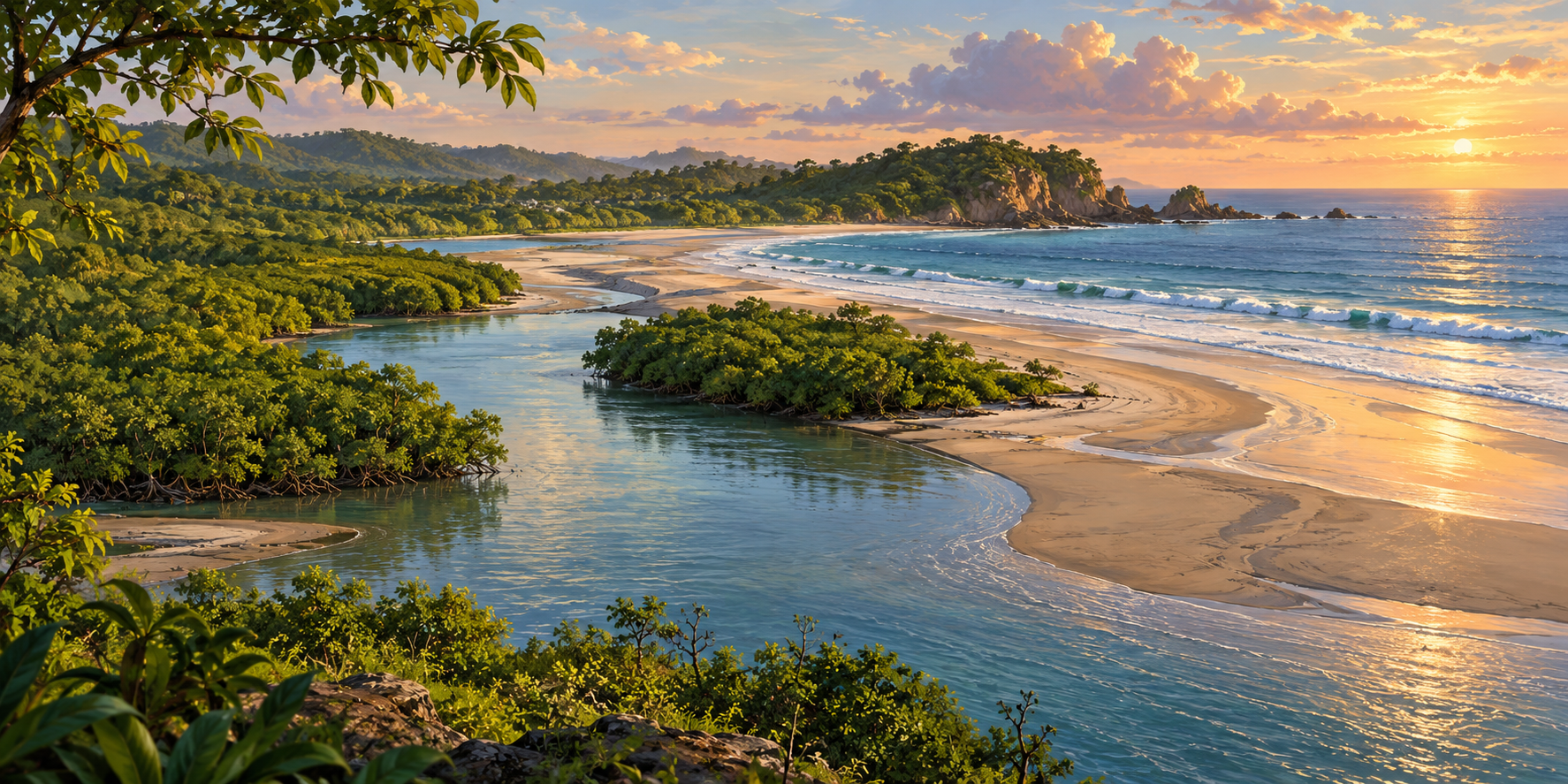
Illustrative AI-generated image created for this story; it is not a documentary photograph.
I walked toward the water expecting a beach, and then the beach became something more complicated. The Pacific was there, broad and restless, but so was the meeting place of the Nosara River and the coast. Land, river, and sea seemed to have made an agreement that none would hold a straight line for long. I stood on the sand and tried to decide where to look first. The answer kept changing.
The sound of the surf reached me before I could see its full width. Closer to the river, the mood softened. The water seemed to gather the light differently, holding a darker reflection beneath the mangroves. I had imagined an easy contrast between a beach day and a nature day. Here they overlapped. I could turn one way and watch waves break on the open shore; I could turn another and study the quieter shapes where the estuary met the trees.
The Costa Rica Tourism Board describes Nosara Beach as a three kilometer stretch and notes the mangrove formed by the Nosara River. It also describes Nosara Point as a rocky area where waves break, with Guiones and Nosara beaches offering opportunities such as horseback riding and estuary boat trips. I carried those facts lightly. They gave me a sense of the geography, but I wanted the day to unfold through attention rather than a checklist of activities.
A shoreline with two rhythms
I began on the open sand. It made me walk farther than I intended, because each curve seemed to promise a slightly different view. The ocean's rhythm was obvious: a line of white water gathered, broke, and spread thinly across the beach. But the shore held smaller rhythms too. Wind moved grains across the surface. A patch of shade shortened as the light rose. My footprints were crisp for a moment and then softened. The scene was never fixed long enough to be mastered.
Near the river mouth I slowed. I knew better than to assume water that looked calm was safe to cross or swim in. Currents and tides can change at a meeting of river and sea, and the point of this journey was to observe the place, not challenge it. I stayed on firm ground and looked toward the mangroves. Their tangled forms gave the river edge a texture unlike the exposed beach. The trees seemed to claim the mud and water together, making a border that was alive rather than drawn.
It took me a while to notice how many shades of green I could see. Some leaves caught the light and looked almost yellow. Others were dark enough to disappear into the background. Between them, the river reflected pieces of sky. I imagined taking a boat through the estuary another day, if conditions and a responsible local operator made it appropriate. For now, the view from shore was plenty. I could feel the place becoming more interesting the longer I stayed still.
I had brought a camera, but the most compelling details refused to become neat photographs. The contrast between surf and river needed more than one frame. The sound of waves behind me and softer water ahead of me could not be captured in an image at all. I wrote a few words in my notebook: two kinds of water, one afternoon. They were not enough to explain the feeling, but they reminded me to keep looking.
The forest close to the coast
When I stepped away from the most exposed sand, the landscape narrowed and deepened. The vegetation along the river changed the light. In the open, I had been aware of the enormous sky; near the trees, I watched for small movements among leaves and branches. I did not attach a species name to every sound. I preferred the honest uncertainty of hearing something and waiting to see whether it appeared.
There is a special kind of quiet near a coastal forest. It is not silence. The surf remains somewhere in the background, and the wind still moves through the leaves. But the space between sounds grows noticeable. I paused long enough that my first hurry began to feel absurd. Nothing at the river mouth required me to be quick. The tide and the river had their own schedules, and my itinerary did not change them.
I thought about how often a place is sold through a single photograph: a perfect wave, a horse at sunset, a canoe beneath a canopy. Nosara can offer more than a single postcard scene, but that richness depends on allowing the surroundings to be complex. The beach is not only for surf. The estuary is not merely an excursion backdrop. The trees are not decorations framing the water. Together they create a coastal landscape with more moods than one traveler can collect in a day.
I turned back toward the sea and saw the open beach differently. The strip of sand now felt like part of a larger system. It belonged to the river as well as the ocean, to the exposed sun as well as the sheltered edge. The waves that had seemed to define the place no longer had the final word. I liked that shift. Travel often changes me through some grand revelation. This time it changed me through a correction of scale.
The pleasure of choosing less
I could have filled the day with activities. The tourism board points to horseback riding and boat trips among the possibilities around Nosara and Guiones. Both can be memorable when chosen with care, but I did not want this story to imply that one experience was guaranteed, suitable for everyone, or essential to the destination. I imagined choosing the simplest plan: walking, pausing, listening, and allowing the place to set the pace.
That choice made room for details I might otherwise have missed. A line of foam reached farther up the beach than the one before it. A piece of driftwood cast a shadow with a strange shape. The surface of the river held a momentary shimmer when the light changed. I noticed my own habit of looking past these things toward a more dramatic moment. Every time I resisted it, the day felt fuller.
I found a place to sit away from the water's edge and watched the two rhythms again. The ocean kept announcing itself. The river offered quieter evidence of movement. They were not opposites; they were neighbors. That thought stayed with me because it seemed to describe the appeal of a Costa Rica journey more broadly. A traveler can seek energy and still make room for calm. A day can feel adventurous without requiring a feat.
I had expected the river mouth to be a stop on the way to somewhere else. Instead, it became the center. I began to imagine returning at a different hour, not to repeat the same scene but to see how the light would rearrange it. A place shaped by water cannot be the same twice. That is part of its appeal, and part of the reason to avoid promising a future visitor a particular photograph.
A changing view of the point
From farther along the shore, I looked toward the rocky forms associated with Nosara Point. Waves broke around them, making the hard shapes visible through movement. I was careful not to romanticize the surf into a harmless spectacle. Beautiful water still deserves respect. I stayed where observation was enough and watched the foam trace temporary lines around the rocks.
The scene reminded me of how much the coast can change within a short walk. At the river mouth, I had been drawn toward mangrove roots and reflected light. Here the eye went to rock and breaking wave. Between the two were stretches of sand that invited a long, unhurried pace. The destination was not a sequence of separate attractions so much as an unfolding coastline. Each part altered the meaning of the others.
I imagined telling someone back home that I had spent most of a day looking at a beach. It would sound simple until I described what I meant: the place where river water approached the Pacific; the mangrove edge; the rocky point; the changes in sound, light, and wind; the decision to stop and look again. There was no need to invent a dramatic encounter. The actual geography was interesting enough to carry the story.
As I walked back, I noticed that I no longer held the same mental picture of Nosara that I had brought. Before, it was a beach name on an itinerary. Now it was a meeting place with several boundaries that kept moving. The experience I imagined was not about finding a secret corner or claiming an untouched landscape. Other people live and work around this coast, and visitors share its spaces. My part was to arrive with curiosity and leave with care.
What I would carry forward
The afternoon grew warmer, and I let the walk end before fatigue flattened my attention. I looked back one last time. The open surf was still easy to see. The river and mangroves took a moment longer to pick out. I liked that the quieter half of the landscape required another look. It felt like the right lesson to take from a place that offers both beach and estuary in one frame.
If I were planning a longer stay around Nosara, I would leave unstructured time near the coast. I might explore whether an estuary outing or another local activity fit the conditions and the people traveling with me, but I would not make a busy schedule the measure of success. The walk itself had shown me how much could happen when I allowed a landscape to develop slowly.
I would also remember that this place has its own changing conditions. Weather, tides, surf, and river flow can alter the experience and the safe choices on any given day. A story can evoke a feeling without pretending to predict those variables. The feeling I wanted to keep was not a guarantee of perfect light or a particular animal sighting. It was the pleasure of being attentive at the meeting of different worlds.
In the end, I did not choose between river and sea. I let both remain in the memory. One offered the expansive sound that had drawn me to the shore. The other offered a quieter line of curiosity that kept me there. Between them, the coastal forest made the landscape feel layered and alive. Nosara had been a name; by the time I turned away, it had become a question I wanted to keep answering.
I imagined the walk appearing in a future travel album as a handful of similar blue and green images. Someone who had not been there might see only a beach. I would remember the changes between those frames: how the sound grew louder as I moved toward open water, how the tree line made the river feel sheltered, and how every pause revealed a new boundary that was less certain than it first appeared. The value of that day lived in the movement between places, not in a single perfect picture.
Editorial note: This first-person story is an imagined traveler narrative informed by official destination information. It does not recount a staff or customer visit. Coastal conditions and activities vary; assess current conditions locally. The accompanying image is AI-generated and illustrative.
A world of wonder awaits
Plan your Costa Rica adventure
Tell our destination concierges what you want from Costa Rica, and we will help shape the journey.