Manuel Antonio: A Day Between Forest and Sea | Costa Rica Travel Professionals
Travel Stories
Manuel Antonio: A Day Between Forest and Sea
The first sound I remember is not the sea. It is the slow, dry scrape of leaves high above the path, followed by a pause long enough to make me stop walking. Morning light slips between the branches in thin columns. Somewhere beyo
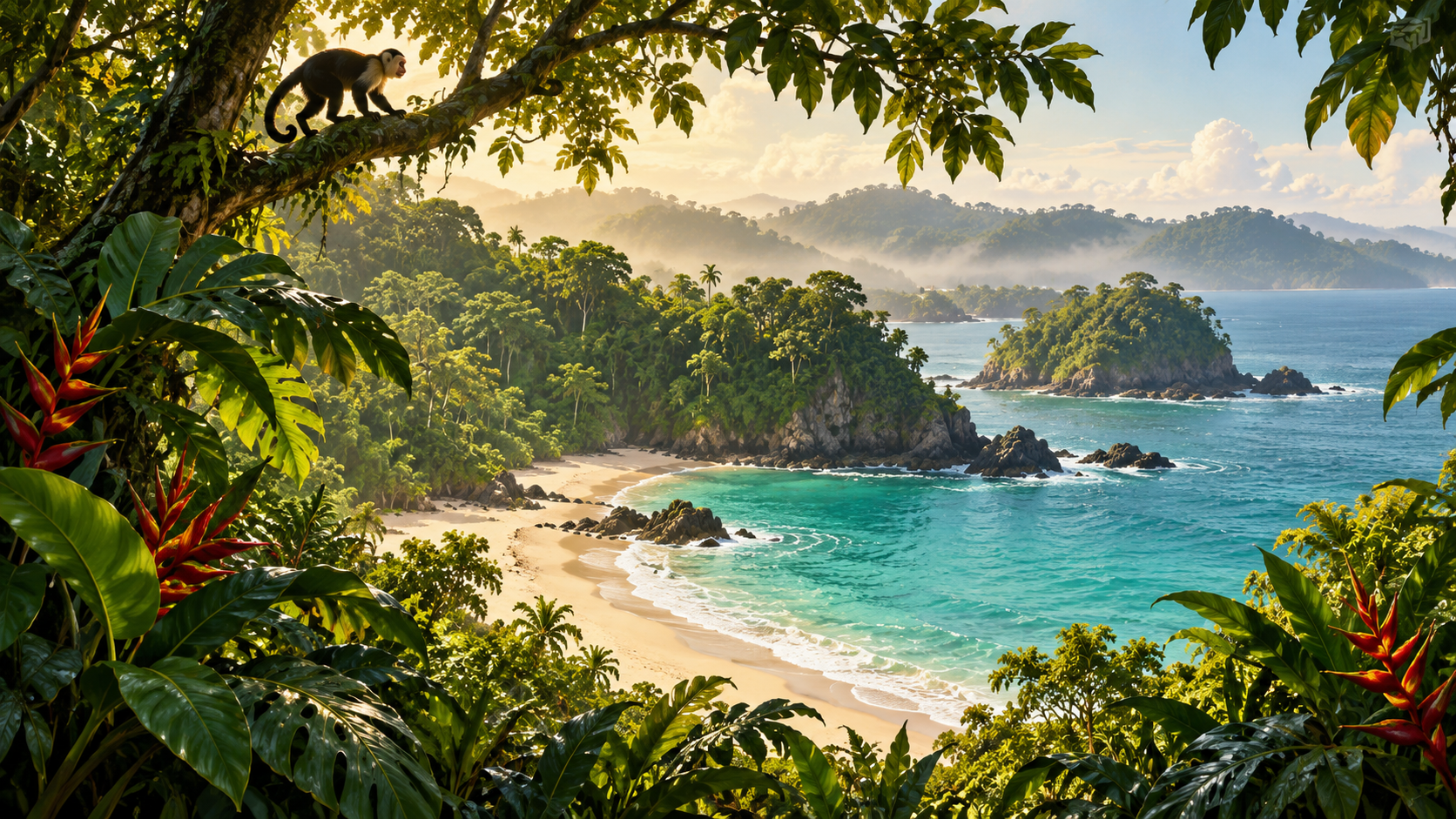
Illustrative AI-generated image created for this story; it is not a documentary photograph.
The first sound I remember is not the sea. It is the slow, dry scrape of leaves high above the path, followed by a pause long enough to make me stop walking. Morning light slips between the branches in thin columns. Somewhere beyond the trees, the Pacific is moving against the shore, but from here it might be another world. I came to Manuel Antonio thinking about beaches. Within minutes, the forest asks for my full attention.
At the park entrance, I put away the little list I had made the night before. It had named the things I hoped to see as if nature worked like a menu: monkeys, a sloth, a bright bird, then a swim. On the trail, the list suddenly feels beside the point. A leaf with rain caught in its fold is worth looking at. So is the dark, polished line of an ant road crossing the soil. I have barely begun, and already the day seems larger than the space I planned for it.
Entering the green
Manuel Antonio sits on Costa Rica's central Pacific coast near Quepos. The national park holds forest, shoreline, mangrove habitat, viewpoints, and beaches close enough together to make the transition from shade to open water feel almost theatrical. Still, close does not mean hurried. I move at the pace the place seems to require, with the warm air settling around my shoulders and the trail turning gently through green.
I have known forest as a quiet place before, but this one is full of small exchanges. Leaves rub together above me. A bird calls from somewhere I cannot place. Then another answers at a different pitch. I realize how often I expect a landscape to announce its highlights. Here, the interesting thing is often half hidden. A curled leaf can be a shelter. A branch that looked empty a moment ago can become a route for movement. The reward for slowing down is not a guaranteed sighting; it is the pleasure of finally noticing how much is already happening.
I stop when someone farther along the path raises a hand, pointing gently upward. For an instant I see only branches layered against branches. Then there is movement: a monkey making its way through the canopy. It is a brief, unposed glimpse. The animal does not wait for me to get a perfect view, and that is somehow the best part. The forest has its own business, and I am a visitor with the good fortune to look in on it.
The temptation is to hurry ahead and see what else might be waiting. Instead I lean against the rhythm of the walk. I notice the difference between the broad, matte leaves near the path and the finer shapes above them. A little breeze reaches the lower branches only after it has passed through the canopy. The air shifts from warm and still to warm and moving. There is no single dramatic revelation, only a sequence of small changes that makes the forest feel alive in every direction.
The art of looking
When I hear the word wildlife, I picture a creature framed cleanly in the open, easy to recognize and remember. The trail makes me revise that picture. A shape can be partly obscured by foliage. A call can come from a bird I never see. I can look straight at a patch of green and miss whatever drew another person's eye. This is not a failure of the day. It is a reminder that the animals here are not arranged for my convenience.
I find myself enjoying the pauses between possible sightings. At one bend, the canopy opens just enough to send a bright splash of sunlight across the trail. At another, the ground is mottled with shadows that shift when the branches move. I can hear my own footsteps and, underneath them, the steadier sound of insects. Every few minutes the sea seems closer, then the forest folds around me again. That back-and-forth gives the walk its pulse.
The park's wildlife can include capuchin monkeys, sloths, coatis, iguanas, and many birds. I hold those possibilities lightly. A destination is richer when I do not turn it into a checklist, and an animal encounter is more meaningful when I remember that it may not happen at all. I keep a respectful distance from the animals I do see. I want the path to feel as undisturbed after my visit as it did when I entered it.
There is a particular pleasure in sharing a discovery without claiming it. When someone quietly gestures toward a branch, I follow the direction of their gaze and then pass the kindness along. Nobody needs to shout. The gesture says enough: look here, but let the moment stay itself. We become a temporary community of people listening and searching, then drift apart at the next curve.
I think of the photos I had imagined taking, the neat evidence of a successful visit. Instead, I lower my phone more often than I raise it. The scene never quite fits inside the frame. The damp brightness, the soft resistance of the air, and the way the path turns toward a voice I cannot identify are all part of the experience. I will still make pictures, but I want to remember what happens just outside them.
Where the trees release the shore
The first glimpse of blue arrives through leaves. It is a small opening, no bigger than a window, and then the path offers a wider view. The sea is suddenly present in color, sound, and space. I can feel the change before I reach the sand: more light on my face, a breeze with a different character, the distant wash of surf resolving into individual waves.
The beaches inside Manuel Antonio National Park are part of what makes this place so compelling. Forest does not end and leave a long blank interval before the ocean begins. The two landscapes seem to speak across the same narrow edge. I step from the shade and look back at the green rising behind me. Only moments ago I was concentrating on a branch overhead. Now the horizon asks me to lift my eyes all the way out.
I leave my bag beside me and sit for a while. Sand gathers against the sides of my feet. The light on the water keeps changing, and the waves leave a brief dark line on the beach before it disappears. I had planned to come here for a swim, but the first thing I want is to do nothing. The forest walk has made stillness feel earned. It has also made me aware that sitting can be a way of paying attention.
There are ordinary details I would have missed if I had rushed into the water: the different sounds made by waves that break close to shore, the way a cloud cools the sand for a moment, the pattern left by a retreating wash of water. I watch people arrive from the trail carrying that same slightly surprised expression. The beach is beautiful, but it is the suddenness of it after the green that gives it such force.
I test the water with my feet and let the next wave move around my ankles. Then I walk a little deeper, watching the shore and staying aware of conditions rather than treating the sea as a backdrop. The coolness is immediate. I turn toward land and see the forest at full height, a layered wall of green above the pale beach. That view changes the way I understand the morning. I have not left the forest behind; I am seeing another side of the same protected place.
A pause between two worlds
Later I return to the sand and let the sun dry the water from my arms. The morning's small sounds come back to me in pieces. I can almost hear the first scrape of leaves, though the surf is louder here. I think about how quickly I had tried to decide what the day should be. A wildlife walk. A beach afternoon. A set of photos. None of those descriptions feels large enough now.
The most memorable moment may be the transition itself. A path that asks me to look inward and upward gives way to a shore that draws my eyes outward. In the forest I learn to focus on a few feet of branch at a time. At the water I can see to the horizon. The shift is simple, but it carries the feeling of having traveled a great distance without going far.
I have to remind myself that this is a national park, not a resort beach. Its beauty is bound up with its protection. The animals are not here to perform for visitors, and the shoreline is part of an ecosystem rather than a stage. That thought does not make the day solemn. It makes me more grateful for what I can enjoy: a trail through living forest, a view of the Pacific, and enough time to let both places change my mood.
As I walk back, I notice how different the same path looks in reverse. A tree that had been a silhouette against morning light now reveals a web of branches. The patch of shade where I stopped earlier is bright. I cannot recreate the exact sequence of the outward walk, and I no longer want to. The park is not a single scene to collect. It is a place that keeps moving while I move through it.
I pass a family walking toward the sea. Their voices carry excitement, and I understand it. I want to tell them about the change ahead, the moment when the sound opens up and the green gives way to blue. But that moment is best discovered, so I only smile and keep going. The day is theirs now, with its own weather, its own pauses, and perhaps a sighting I will never know about.
The memory I take away
By the time I leave the park, I am a little tired, pleasantly sandy, and unwilling to reduce the visit to one favorite image. If I say the beach was beautiful, I leave out the walk that made it so startling. If I say I saw wildlife, I leave out the searching and listening that gave the sighting meaning. The story is in the movement between these things.
I think about returning another day and wonder what I would notice with less eagerness to cover ground. Perhaps I would spend longer at the first bend. Perhaps the forest would be quiet and the sea restless, or the reverse. Maybe I would see no monkey at all. A visit like this does not promise repetition. That is part of why it stays with me.
On the way back toward Quepos, the park seems to remain in two parts of my senses at once. I can still feel the cool change where the tree cover thickened. I can still see that open line of water beyond the sand. One place held both experiences, and the short distance between them made each one sharper.
Manuel Antonio reminds me how generous a day can feel when I stop measuring it by the number of things I accomplish. The forest gave me a reason to slow down. The beach gave me room to breathe. Between them, I found the kind of travel memory that cannot be pinned to a single photograph: a sequence of light, sound, movement, and the welcome surprise of arriving somewhere familiar in name but entirely new in feeling.
If I were planning this day again, I would still make space for both trail and shore, but I would leave the middle unwritten. I would bring patience, watch where I step, and give the wildlife its distance. I would let the forest be more than a passage to the beach and the beach be more than a reward for the walk. The park's gift lies in their connection. In a few hours, it lets me feel the intimate scale of a leaf and the immense scale of the Pacific, and I leave carrying both.
Editor's note: This first-person story is an illustrative, researched narrative created for travel inspiration. It does not recount an actual visit by a Costa Rica Travel Professionals staff member or customer. Wildlife sightings, weather, and conditions vary. The accompanying image is AI-generated and illustrative.
A world of wonder awaits
Plan your Costa Rica adventure
Tell our destination concierges what you want from Costa Rica, and we will help shape the journey.