Irazú Volcano Above Cartago | Costa Rica Travel Professionals
Travel Stories
Irazú Volcano Above Cartago
Cartago was still waking when I began the climb toward Irazú. The road rose through a landscape that seemed to stretch and fold at the same time. I watched houses and fields appear, then fall behind us as the air cooled. The volca
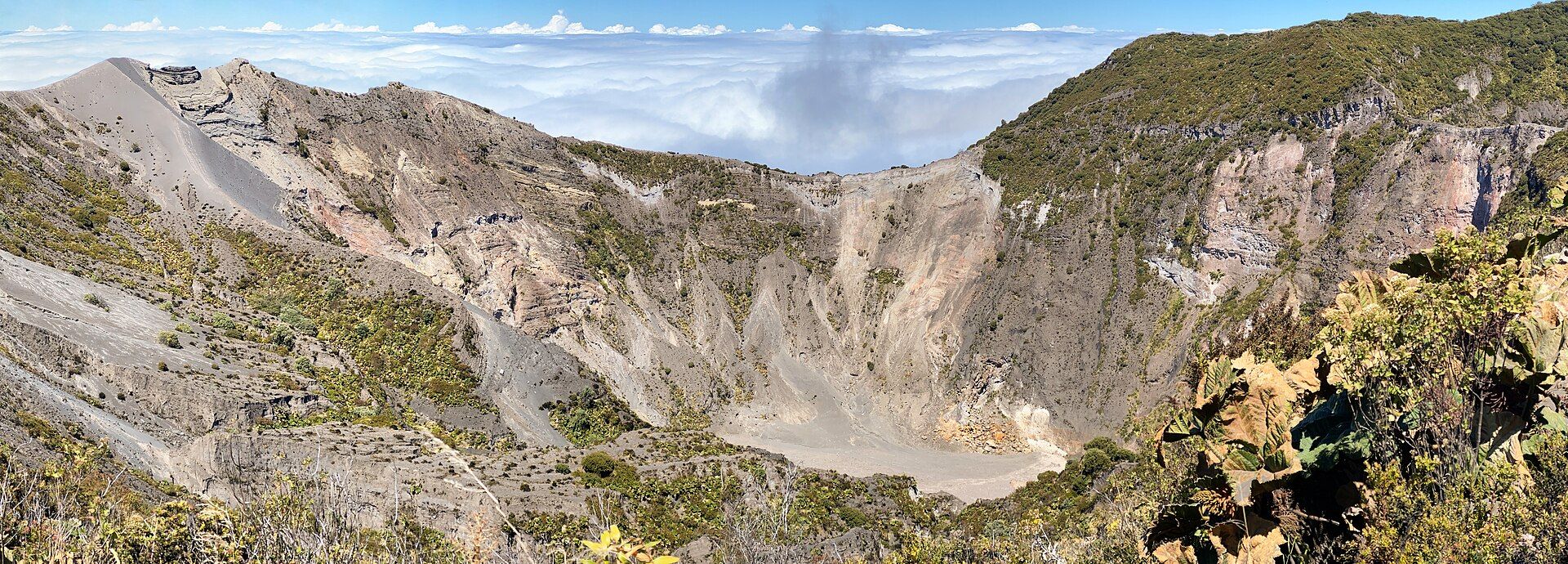
Image: File:Irazú Volcano 01.jpg by Bernard Gagnon, via Wikimedia Commons (https://commons.wikimedia.org/wiki/File:Iraz%C3%BA_Volcano_01.jpg). License: CC0 (https://creativecommons.org/publicdomain/zero/1.0/). Cropped for display.
Cartago was still waking when I began the climb toward Irazú. The road rose through a landscape that seemed to stretch and fold at the same time. I watched houses and fields appear, then fall behind us as the air cooled. The volcano was the day's destination, but the ascent felt like a gradual invitation to notice how many versions of Costa Rica could exist within one morning. The sounds of the city softened; the high country opened. I had packed a layer against the chill and carried a hope for clear skies, though I knew the mountain made no promises.
From below, a volcano can become a simple shape on a map. On the way up, Irazú became a sequence of changes. The light grew sharper, then disappeared behind cloud. The vegetation shifted in ways I could see even without naming every plant. The air felt thinner and cooler on my face. I thought about the people who live and work along this route, for whom the mountain is part of an ordinary horizon rather than a once-in-a-lifetime sight. My journey was brief; their relationship with this landscape continued after I passed. That thought made me look more carefully, not just at the summit but at the places along the way.
At the park, I followed the designated access and let the wide volcanic terrain come into view. The first impression was space. Irazú did not resemble the lush postcard I might have imagined for Costa Rica. Its crater landscape had a spare, almost lunar quality, with broad forms and colors that encouraged a slower gaze. I stayed where visitors were meant to be, aware that protected areas and active volcanic terrain deserve attention to current rules. The scene did not need a dramatic approach. It was powerful because it was open, because the eye could travel farther than the feet should.
I stood at a viewpoint and tried to understand the shape of the principal crater. Its scale resisted the usual habit of comparison. From a safe distance, textures that might have been rough and immense looked smooth, while the rim gave me a reference for the depth beyond. Cloud moved overhead, altering the contrast from minute to minute. I had come hoping for a clear photograph, but the mountain kept changing the composition. The view felt less like a picture to capture than a place to spend time with. Each shift of light revealed another contour.
The official tourism description names several geological features here, including the Principal and Diego de la Haya craters and the Sapper formation. I did not need to visit every named point to feel the complexity of the site. Knowing they existed helped me resist reducing Irazú to one crater photograph. The park held a larger volcanic story, one written across different forms of rock and open ground. I could follow the visitor route, read what was available, and still accept that most of the mountain's history would remain beyond my immediate understanding. Awe and humility sat comfortably together.
The air carried a highland edge, cool enough that I noticed my breathing. I looked toward the horizon and wondered whether the distance would open enough to show the two coasts sometimes associated with this high point. I did not count on it. Visibility is a gift of conditions, not a guaranteed feature of a ticket. On this imagined day, cloud and light traded places across the far hills. That shifting view seemed more honest than a promise of an impossible panorama. The mountain was already offering plenty: a sense of elevation, a volcanic landscape, and the strange pleasure of feeling the weather move around me.
I thought of the road below and the city of Cartago beyond it. The contrast was part of the experience. Down there, streets organized movement into familiar routes. Up here, the exposed terrain reminded me how much older the ground was than any plan drawn upon it. I did not need to turn that thought into a lecture on geology. It was enough to stand still for a minute and feel my day become smaller beside the mountain's time. Travel sometimes invites escape from routine; Irazú offered perspective instead, a way to see routine within a wider frame.
I walked on, noticing how sparse and vivid the scene could be at once. A subtle change in color across the ground caught my eye. The edge of a cloud drew a moving shadow along the crater. A patch of vegetation held its place against the open volcanic setting. In a rainforest, abundance can make it hard to choose where to look. Here, the apparent simplicity made every difference more visible. I began to understand why the site was memorable even when the weather refused to provide a perfect blue sky. The mountain had its own palette.
A group of visitors approached, then passed, their voices briefly filling the open air. Soon the sound thinned again. I appreciated the shared wonder without pretending to know anyone else's experience. One person might be thinking about geology, another about the view, another simply about the cold. My own attention moved between them all. I had arrived expecting to feel close to the sky. Instead I felt close to the ground, aware of the terrain beneath me and the forces that had shaped it. That was a more surprising and lasting connection.
The decision to spend time rather than hurry gave the morning a different shape. I had seen travelers approach a viewpoint, take a photograph, and leave before the cloud moved. I understood the temptation. There is always another stop waiting, especially in a country with so many distinct places close enough to connect in one itinerary. Yet Irazú rewarded patience. A few extra minutes changed the light, and a few more changed the view again. Even when no distant coast appeared, the mountain kept revealing smaller things to anyone who stayed.
I remembered reading that Irazú is Costa Rica's tallest volcano. The fact made sense in the air and the breadth of the view, but it was not the reason I cared about the place by the time I turned back. Numbers can introduce a destination; they rarely carry the whole memory. I would remember the pressure of cool air at the edge of a crater, the open ground under a restless sky, and the road unwinding toward Cartago. Those details gave the elevation human scale without reducing its grandeur.
On the descent, the high volcanic scene did not vanish all at once. It softened by degrees. The road passed through cloud, then sun, then another patch of mist. The vegetation grew fuller. I felt the warmth returning. Looking back was less useful than looking around, because the mountain's influence continued through the landscape we crossed. The trip up had trained my attention; the trip down gave it somewhere new to rest. I noticed the shape of fields and the movement of clouds over ridges I had barely seen earlier.
I imagined stopping in Cartago later, letting the city's everyday sounds bring me back to a different scale. The thought made me appreciate the structure of the day: a morning among volcanic craters, an afternoon in the life of a valley city. Neither scene canceled the other. Together they made Costa Rica feel layered rather than neatly divided into nature and culture. A carefully planned route could allow time for both, without asking a traveler to rush past the people and places between them. The journey was not only the summit; it was the connection.
When I tried to explain Irazú to myself, I kept returning to the word spacious. The terrain had room for silence, for shifting weather, and for questions I could not answer. It did not ask for the exuberant language of a jungle encounter. Its beauty was more austere: broad crater forms, high light, the sense of land remade over time. That difference mattered. It reminded me that Costa Rica's appeal is not one repeating scene of lush green. The country also holds open volcanic heights that can make a traveler feel briefly suspended between earth and sky.
The weather might have been clearer on another day. It might also have been less forgiving. I would never tell someone to plan a visit around a guaranteed view or ignore current guidance to chase one. The uncertainty belongs to the experience. What can be planned is the care around it: checking official access information, dressing for highland conditions, and allowing time for the landscape to unfold. With those choices in place, even a clouded morning could become memorable. The destination is not a photograph owed to us; it is a place we are invited to meet as it is.
That evening, I pictured the mountain from below again. It had returned to an outline against the distance, yet I knew what the maplike shape concealed: the spare crater terrain, the moving shadows, the sudden coolness, the visitor path holding people safely at the edge of something immense. I had not solved Irazú, and I did not want to. The experience had widened my sense of what a Costa Rica journey might contain. It could be intimate and expansive in the same day, moving from a road above Cartago to a horizon altered by cloud.
I would carry that spaciousness into the next destination. When plans tightened, I would remember standing still while the light changed over the crater. When I caught myself asking whether I had seen enough, I would think of how much appeared only after I stopped trying to finish the visit. Irazú had offered no single perfect moment. It had offered a series of partial views that made a whole feeling. That was enough to turn a highland morning into a story I could imagine telling slowly, with room left for the mountain's silence.
The last image was simple: cloud passing over the open volcanic ground, then lifting. For a moment the colors deepened and the crater's shape became more distinct. I did not reach for my phone. I let the change happen and pass. In that brief interval, the mountain felt neither remote nor conquered. It was present, and I was present with it. For a traveler who had begun the day thinking mainly about reaching the top, that was a satisfying place to arrive.
On the way down I found myself imagining the same road traveled in the opposite direction by someone with a different reason to climb. A geologist might read the rock with a precision I lacked. A family might remember the children's surprise at the cold. A local resident might notice a change in cloud that I would miss entirely. My story could never stand for all of theirs. It was one imagined walk through a place generous enough to hold many ways of seeing. That thought made the landscape feel more alive than any attempt to declare its single meaning.
The mountain also changed how I thought about the rest of the itinerary. I had been tempted to arrange every day around a peak moment, a famous sight at the center and everything else orbiting it. Irazú suggested a looser pattern. The road, the weather, the descent, and the city below all shaped the experience. I wanted the next destination to have that same breathing room. A journey can be carefully designed and still leave space for a cloud to become part of the story.
Editorial note: This is an illustrative first-person story, imagined from research to inspire travel. It does not describe a real visit by Costa Rica Travel Professionals staff or a customer. Check current park access and weather before planning.
A world of wonder awaits
Plan your Costa Rica adventure
Tell our destination concierges what you want from Costa Rica, and we will help shape the journey.