Guayabo National Monument: Ancient Stonework | Costa Rica Travel Professionals
Travel Stories
Guayabo National Monument: Ancient Stonework
The stones did not announce themselves all at once. I arrived expecting an archaeological site and found, at first, a landscape of green and shadow. Then a curve emerged from the ground. Another line met it. A path made of careful
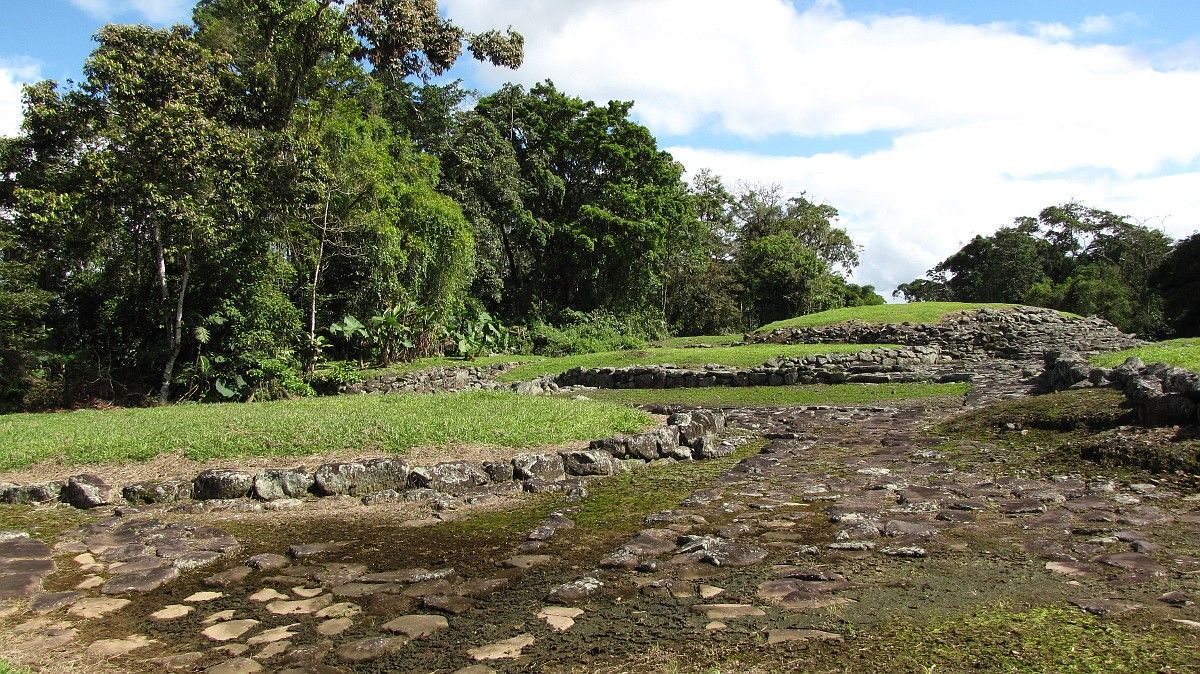
Image: File:Guayabo.jpg by Lutz Maertens, via Wikimedia Commons (https://commons.wikimedia.org/wiki/File:Guayabo.jpg). License: CC BY-SA 3.0 (https://creativecommons.org/licenses/by-sa/3.0/). Cropped for display.
The stones did not announce themselves all at once. I arrived expecting an archaeological site and found, at first, a landscape of green and shadow. Then a curve emerged from the ground. Another line met it. A path made of carefully placed stone drew my eye forward. The shapes were modest compared with the towering ruins I had seen in photographs from elsewhere, but their restraint made me pay attention. I felt as though the place was asking me to read rather than simply look.
Guayabo National Monument is near Turrialba in Cartago province. Costa Rica's conservation agency, SINAC, identifies it as an archaeological protected area. The Costa Rica Tourism Board describes ancient structures and the story of people who lived here long before the modern nation. I came with those facts in mind, but standing beside the stonework shifted the question. I was less interested in how to summarize Guayabo than in how much patience it would take to see its design.
I walked slowly. My shoes made a soft sound on the ground, and the air held the damp smell of vegetation. Each visible stone seemed both ordinary and extraordinary. A single stone could be found anywhere. Here, thousands of choices of placement had become routes, circles, and water works. I could not know the hands or voices behind them. I could acknowledge the work and resist filling the silence with a story I had invented about its builders.
Looking at the ground differently
I had visited natural landscapes where the eye lifted toward a canopy or a horizon. At Guayabo, it kept returning to the ground. A curve in the stone suggested a space that once had another form. A passage asked where it led. The remains made absence visible. I found that more moving than a complete reconstruction might have been, because it left room for questions without pretending to answer them all.
The tourism board notes the site's stone paths, mounds, and water management features. I tried to see them as parts of a lived place rather than a set of isolated objects. People must have moved between spaces, carried materials, gathered, and worked. Those are broad human activities, not claims about a specific ritual or event. Even with that caution, the layout stirred my imagination. I could sense the intention in the lines while recognizing how much I did not know.
I stopped at one stretch of stonework and watched how the light crossed it. Darker gaps made the edges more visible. Small plants had found spaces nearby. The contrast between built form and living vegetation was not a simple contest between past and present. The protected site held both. It preserved traces of human engineering within an environment that continued to change around them.
There is a habit of calling archaeological places “lost.” I felt uneasy with the word here. The stones were visible, cared for, and part of Costa Rica's heritage. The people connected to pre-Columbian history cannot be reduced to a vanished mystery for a visitor's entertainment. I wanted to learn from the site's official interpretation and leave room for what scholarship still does not establish. Curiosity did not require romantic certainty.
The intelligence of water
The idea of water management stayed with me as I moved through the site. It is easy to admire a wall or a paved path because the form is visible. A water system asks for a different kind of attention: to slope, flow, containment, and the practical intelligence of placing things exactly where they need to be. I imagined the challenge of shaping a settlement in a wet landscape. I did not have to invent a technical explanation beyond the official evidence to be impressed by the ambition.
I looked at the stone again with that thought in mind. The individual pieces no longer seemed like static remnants. They were parts of a design that had served daily life. They connected places and solved problems. The story of ancient engineering can sound abstract in a book; in front of the stonework, it felt grounded. The people who made it were not a vague chapter labeled “the past.” They were capable builders who understood their terrain.
For a moment I wanted a complete scene: the structures as they once stood, voices around them, a precise answer to every question. Then I realized that such a scene, presented as fact, would be more about my imagination than their history. The honest experience was better. I could stand in a place where traces remained, read what the evidence supported, and let uncertainty be part of the encounter.
The forested surroundings gave the visit another dimension. Leaves moved above the stone. Moisture softened the light. The air felt different in open and shaded sections. I was aware that weather could transform the atmosphere on any given day, and that this imagined walk could not stand in for another person's conditions. What seemed constant was the relationship between built remains and the landscape that held them.
A pause for interpretation
I sat for a while and thought about how travel changes when a place is approached with questions instead of expectations. If I had come looking only for a dramatic ruin, I might have hurried through Guayabo and missed its careful geometry. The quieter forms rewarded a visitor willing to examine them. A curve mattered. A transition between levels mattered. The path itself mattered, not only the point where it ended.
I considered how I would describe the site to a friend. I would begin with the experience of following stone lines through green surroundings. Then I would explain that Guayabo offers evidence of pre-Columbian settlement and engineering. I would be careful with claims about dates, population, and purpose unless I had checked the latest interpretation. It is tempting to repeat an impressive number or a dramatic theory. Here, precision felt like respect.
The monument also widened my idea of a Costa Rica itinerary. A country celebrated for wildlife and beaches holds layers of human history that deserve their own time. Guayabo was not a brief cultural add-on to a nature trip. Its stonework was a destination in its own right, one that made me look at the relationship between people and environment from another angle.
I returned to the path and noticed the way my pace had changed. Earlier I had moved slowly because I was unsure what to see. Now I moved slowly because there was too much to consider. Every visible form suggested decisions made long ago, and every gap reminded me of the limits of the surviving record. I found that combination of evidence and uncertainty compelling.
What remains, and what does not
Standing among ancient remains can encourage a kind of false intimacy. It is easy to imagine that a visitor can feel exactly what someone centuries ago felt in the same place. I resisted that idea. I could feel my own response to the site; I could not claim access to another person's inner life. The stones made that difference clear. They offered material evidence, not a script for me to perform.
That distinction made the visit more human. I could admire the design without turning its makers into symbols. I could wonder about daily routines without inventing specific scenes. I could appreciate the work of preservation and interpretation that allows present-day visitors to encounter the place. Guayabo felt alive as a site of learning, even though the visible remains belonged to a distant past.
The path seemed shorter on my return, as paths often do once the eye knows them. I paused at a spot I had barely noticed earlier and saw how several lines of stone related to one another. It was not a revelation so much as a correction: I had looked but not yet seen. I thought of how much more I might learn with a knowledgeable guide or more time spent with official materials. The site did not close with my visit. It opened a line of inquiry.
I left without trying to collect every fact. What stayed with me was an image of patient construction: stone placed beside stone, water considered, movement guided. Those choices had outlasted the people who made them, while remaining incomplete to my modern eye. The gap between survival and loss was part of Guayabo's power.
Carrying the question onward
Back in my imagined travel notes, I would put Guayabo beside the rainforests and volcanoes, not beneath them. It adds a necessary human dimension to a journey through Costa Rica. The country has never been only scenery. The monument asks visitors to recognize complex histories in the same terrain they may have come to admire for its natural beauty.
I would tell a traveler to allow unhurried time here and to approach the site with humility. Read what the official interpretation says. Notice how the stonework fits together. Ask questions that do not have immediate answers. Avoid treating the place as a backdrop for a quick photograph. Those suggestions are not complicated, but they changed the visit I imagined.
The final detail I carried away was a curve of stone disappearing into green. I could not see where every line had once led. I did not need to. The visible part was enough to make me aware of a larger design. Guayabo gave me a quieter kind of awe: not the shock of a vast view, but the realization that careful human work can remain legible long after its full story is beyond reach.
Later, I imagined laying the day's photographs side by side. They would show sections of path and circles of stone, all useful reminders, yet the sequence would miss the most important change: the way my questions had become more precise. At first I wanted to know what the site was. By the end I wanted to know how its parts related, what evidence explained those relationships, and how conservation staff protect the remains while allowing people to learn from them. That felt like a better outcome than a tidy answer. The monument had given me a reason to keep reading.
I also thought about the difference between visiting with wonder and visiting as though the past were mine to narrate. The first leaves space for the people whose history the site represents and for researchers who study its evidence. The second replaces them with a visitor's fantasy. I wanted my memory of Guayabo to rest on what I could truly say: stonework survives in a protected landscape near Turrialba; it shows planning and skill; it rewards patient attention. The unanswered questions made the encounter deeper, not weaker.
Even after I imagined the path out, I found myself slowing whenever I saw a line of stones. Guayabo had changed the way I read ordinary materials. A stone may be natural, moved, selected, fitted, repaired, or preserved. Without context I cannot tell which story it carries. At the monument, context gives the visible remains meaning and also sets limits on interpretation. I wanted to keep both lessons: look closely, and ask what supports the story I am about to tell.
Editorial note: This first-person story is an imagined traveler narrative informed by official information. It does not recount a staff or customer visit. Archaeological interpretation should be checked against current on-site and SINAC materials.
A world of wonder awaits
Plan your Costa Rica adventure
Tell our destination concierges what you want from Costa Rica, and we will help shape the journey.