Golfo Dulce: Mangroves and Marine Life | Costa Rica Travel Professionals
Travel Stories
Golfo Dulce: Mangroves and Marine Life
The water looked almost still when I first saw Golfo Dulce, but the longer I watched, the more movement emerged. Small ripples crossed one another. A darker band beneath the sky hinted at an approaching breeze. Along the shore, th
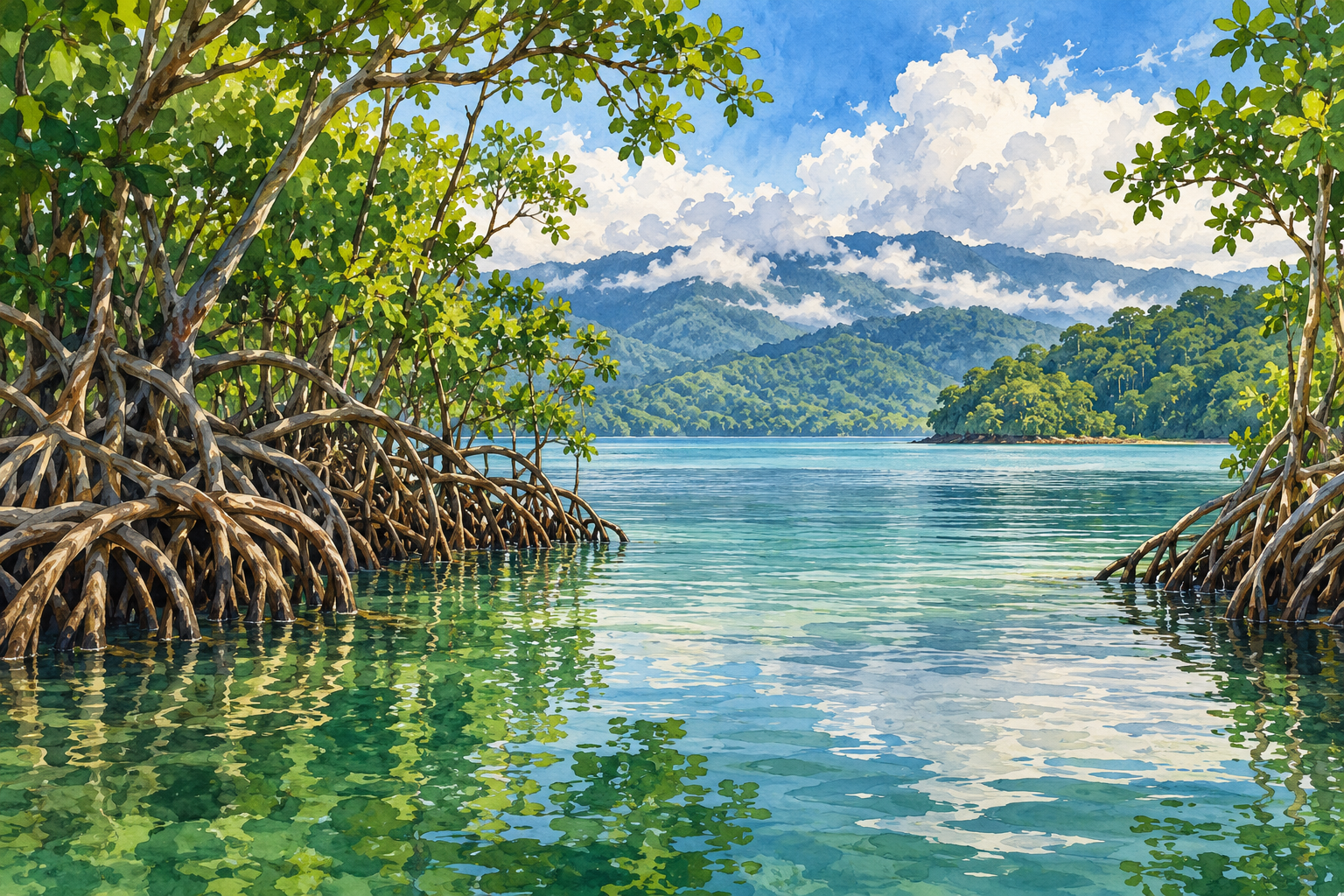
Illustrative AI-generated image created for this story; it is not a documentary photograph.
The water looked almost still when I first saw Golfo Dulce, but the longer I watched, the more movement emerged. Small ripples crossed one another. A darker band beneath the sky hinted at an approaching breeze. Along the shore, the green of the forest seemed to lean toward the gulf. I had come looking for the meeting place between mangroves and open water, drawn by the possibility of seeing marine life. Yet before we set out, I was already interested in the quieter question the landscape posed: how much could I notice if I stopped expecting every minute to produce a sighting?
We left the shore at an unhurried pace. The boat's motor made conversation difficult for a moment, then the guide slowed where the channel invited closer attention. Roots were visible near the water's edge, forming an intricate border that no straight line on a map could describe. I knew mangroves played important ecological roles, but the view made that knowledge feel less abstract. This was not simply scenery behind a boat tour. It was a living edge, where land and water meet, sheltering organisms I could not necessarily see from my seat.
I kept my binoculars ready and my expectations light. Golfo Dulce is recognized for its marine mammals, including dolphins and visiting humpback whales, but “possible” is not the same as “promised.” The World Cetacean Alliance describes the gulf as an important area for cetaceans, and that made me even less inclined to turn an encounter into a demand. Animals travel on their own terms. A responsible outing would follow appropriate wildlife viewing practices and let distance be part of the experience. I could enjoy the anticipation without requiring the sea to deliver a performance.
The guide pointed toward a change in the water, and we all looked. It might have been a passing current or the surface mark of something moving below. For a moment I forgot to breathe. Then nothing more appeared, and the boat continued. I smiled at my own impatience. So much of travel writing edits out these unconfirmed moments, as if uncertainty were an embarrassment. Here it was part of the story. We had noticed, wondered, and let the question pass without inventing an answer. The gulf remained full of life even when it kept most of that life from view.
Near the mangroves, the air had a different smell, a blend of salt and wet earth. Light reached the water in uneven patches where branches opened. I could hear the soft knock of water against the boat and, occasionally, a bird calling from farther inland. The scene asked for careful movement. We stayed in the boat and followed the guide's instructions about where to go. Roots and shallows were not obstacles to conquer for a closer photograph. They were part of the habitat. From where I sat, the pattern of leaves and reflections was already more than enough to hold my attention.
As we moved into a wider stretch of water, the sense of space changed. The mangrove edge became a green ribbon, and the opposite shore looked distant. Golfo Dulce can be described as a gulf or a fjord-like embayment, but neither phrase captures the feeling of being surrounded by forested land while floating on open water. I turned slowly to take it in. Some landscapes offer a single heroic viewpoint. This one offered relationships: river to sea, shore to forest, quiet coves to the wider Pacific beyond. The pleasure was in sensing those connections, even if I understood only a fraction of their ecology.
The boat stopped in a suitable place, and the guide gave us a chance to listen. Without the motor, sounds became more delicate. A small wave lifted the hull. Wind moved through vegetation along the shore. I heard another traveler's camera click and then the silence after it. I put my own camera down. The color of the gulf seemed to change while I watched, brown-green in one direction, silver where the sun broke through. I did not need to name every cause to enjoy the effect. The day was teaching me that observation can be satisfying even without certainty.
I thought about the people who live around the gulf. From a boat, a coastline can appear like pure nature, but there are communities, working waterfronts, conservation efforts, and daily routes throughout the region. My sense of remoteness was a visitor's impression, not a complete description. I wanted to avoid the lazy phrase “untouched paradise.” It erases human relationships with the place and the work of protecting it. A better story would make room for both the lush habitat and the lives that have long been connected to these waters.
A flash of movement caught my eye ahead. We waited without advancing aggressively. For a few seconds I watched the surface, trying to distinguish wave from animal. If a dolphin had surfaced, I would have welcomed the glimpse; if it did not, I would still have had the gift of attention. The guide's judgment mattered more than my desire for a photograph. I would rather return with a true account of not knowing than with a story that pressed too close to wildlife. The gulf's marine life was part of why I came, and respecting its space was part of what it meant to visit.
As we passed another stretch of shoreline, I noticed how the mangrove roots appeared to hold shadow and light at once. Some seemed dark and solid; others dissolved in reflection. The water concealed their lower parts, so the forest looked as if it were standing on a moving mirror. I leaned back and watched instead of reaching for an identification chart. Later, I could learn more about the species and ecology. In the moment, the strongest lesson was visual and physical: this edge was complex, not the simple strip of green I had imagined from a map.
The Costa Rican Tourism Board has written about the broader Golfo Dulce Forest Reserve and its rich land habitats. I kept that in mind without confusing a forest reserve with the entire marine gulf. Place names can overlap in travel writing and create false impressions of one uniform protected space. On this boat ride I was seeing waterways and shorelines that demand their own local guidance. The distinction made me more curious. What forms of protection applied here? Who monitored wildlife viewing? Which areas should remain undisturbed? Those were practical questions, not just footnotes to a beautiful day.
By midday the light had become stronger. We drank water and found a patch of shade. I had not realized how much time I had spent scanning the surface until I relaxed my eyes. Immediately I noticed the larger landscape again: the blue-gray hills, the layered green of the shore, the reflected clouds sliding across the gulf. It was easy to let the hope of one extraordinary animal shrink the rest of the place. I wanted the whole experience. If a marine mammal appeared, it would be one part of the day, not its only justification.
On the return, the route looked new because of the changed light. The mangroves seemed denser, the water more textured. I watched a bird cross the open space and vanish into green. I could not name it, and that was fine. I felt a small pang when the shore came close, not because the tour had failed to deliver a promised sighting but because I had settled into its rhythm. The boat had become a place to practice patience, moving steadily through a world that was never completely visible.
The World Cetacean Alliance's recognition of Golfo Dulce as a Whale Heritage Area gave me a phrase for its importance, but the morning gave me a feeling for what responsible attention might look like. I did not need to claim an intimate encounter with whales to understand why their habitat matters. The possibility of their presence, together with the known role of the gulf for dolphins and other life, made each decision about distance and speed feel consequential. Conservation is often spoken of in large terms; from a boat it can be measured in how a guide approaches a shoreline or chooses not to pursue a moving shape.
Back on land, I found myself describing the mangroves first. That surprised me. Before the trip I had pictured an animal breaking the surface as the defining image. Instead I remembered the interlaced roots, the change from narrow channel to broad gulf, and the silence after the motor stopped. Marine life had been present in my thoughts, and perhaps glimpsed in uncertain movement, but the habitat had been unmistakably there. It held the possibility of encounters without owing me any. I liked that my strongest memory was of the place that makes life possible.
I would encourage another traveler to come with the same balance of hope and humility. Choose a knowledgeable operator, ask about wildlife viewing practices, and let the guide respond to current conditions. Bring binoculars if you enjoy them, but give your eyes a rest from scanning. Notice the roots and the reflections, the communities along the shore, the way the gulf changes color under passing cloud. A sighting can be unforgettable, yet the day can be beautiful without one. The value of the journey lies in meeting a living waterway on terms that allow it to remain alive.
That evening, when the light softened over Golfo Dulce, I thought once more about the first impression of stillness. The water had never been still. My own attention had needed time to catch up with its motion. Travel can do that when I let it: replace a ready-made image with a more complicated, more generous reality. I came hoping to see marine life and left thinking about all the life that remains hidden under and beside the water. The gulf had not become a possession in my memory. It had become a question I wanted to keep asking with care.
I wrote a final note to myself before the day ended: remember the edges. The mangrove roots were an edge between land and sea; the changing light was an edge between what I could see and what remained concealed; our boat occupied an edge between curiosity and intrusion. Thinking in those terms made the outing feel less like a search for one perfect moment. It became a sequence of choices about how close to look and when to let the landscape keep its distance. I could still hope to return and see a dolphin on another day. I would also return for the slow passage through green water and the chance to listen more carefully.
I had once thought that a wildlife outing needed an unmistakable encounter to become a story. Golfo Dulce challenged that idea. The guide's pauses, the changing shoreline, and my own rising and falling expectations formed a story with no need for a staged climax. I was still eager to see marine mammals someday, but I now understood that their absence from my view could leave their habitat no less deserving of wonder or care.
Editorial note: This first-person story is an illustrative narrative composed from research. It does not describe an actual visit by a Costa Rica Travel Professionals staff member or customer. Wildlife encounters are never guaranteed; tour routes and conditions should be confirmed locally. The accompanying image is AI-generated and illustrative.
A world of wonder awaits
Plan your Costa Rica adventure
Tell our destination concierges what you want from Costa Rica, and we will help shape the journey.