Drake Bay: Gateway to the Osa | Costa Rica Travel Professionals
Travel Stories
Drake Bay: Gateway to the Osa
The boat's movement changed as we approached Drake Bay. Open water gave way to the calmer sense of a coast drawing near, and I began looking for the place where the forest ended and the village began. The boundary was hard to find
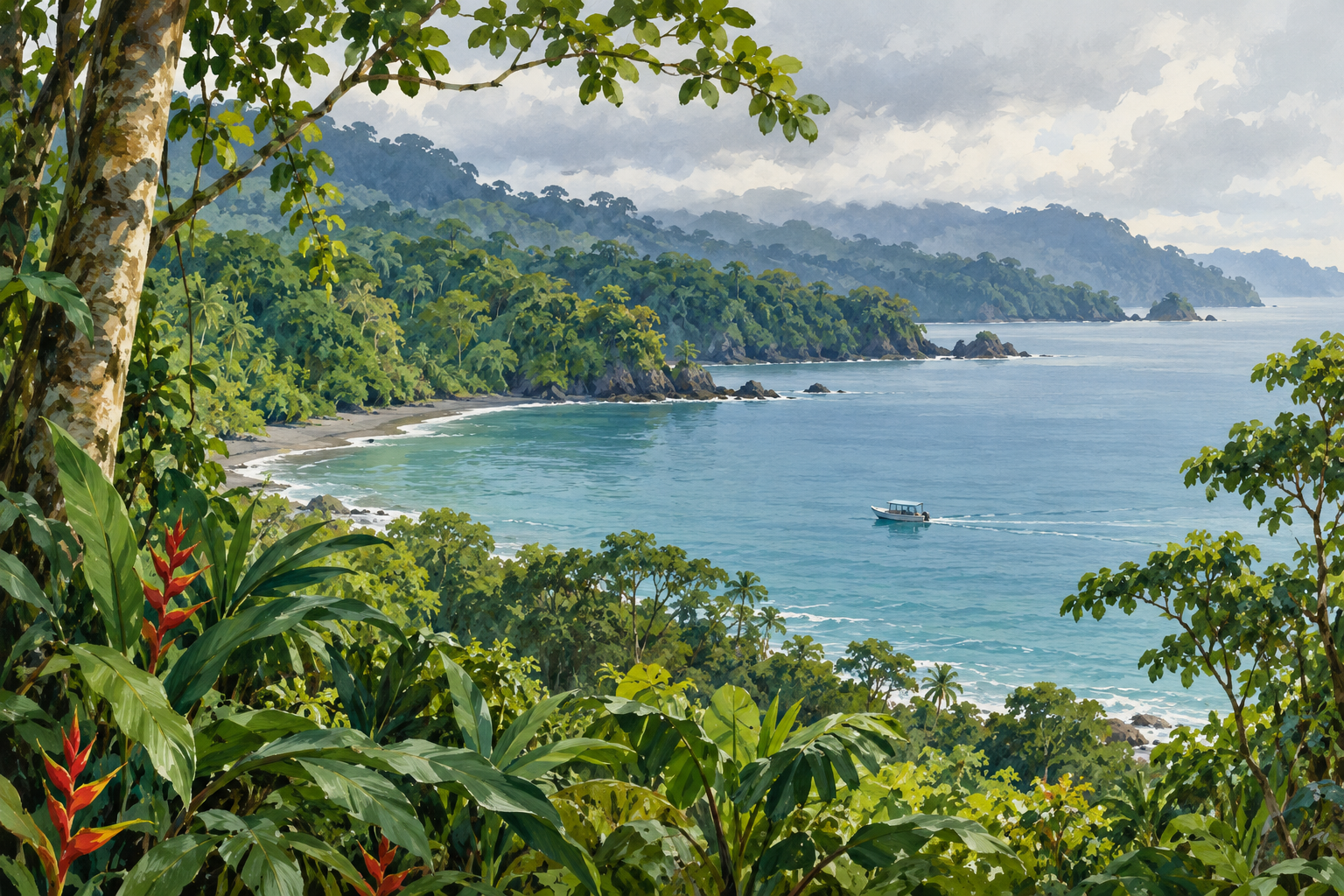
Illustrative AI-generated image created for this story; it is not a documentary photograph.
The boat's movement changed as we approached Drake Bay. Open water gave way to the calmer sense of a coast drawing near, and I began looking for the place where the forest ended and the village began. The boundary was hard to find. Green crowded toward the shoreline, while rooftops appeared almost modestly among it. I had traveled here because the Osa Peninsula had occupied my imagination for years, yet arrival did not feel like stepping into a poster. It felt like entering a place with its own weather and daily rhythm. I held my bag close, waited my turn, and tried to notice more than the view.
I had heard Drake Bay described as a gateway, usually in the same breath as Corcovado National Park. The phrase is useful, but it can make a community sound like a doorway to somewhere more important. As I walked into the village, I wanted to let it have a day of its own. A path rose gently from the water. A bird called from an unseen branch. The air had the heavy softness of a place where rain might arrive without asking me to rearrange my schedule. I could feel the urge to rush ahead to the park, and I decided to resist it.
The first walk was deliberately small. I followed the coast as far as the path and conditions made sense, with no goal of claiming a long hike. The edge between shade and sunlight shifted every few steps. Leaves were glossy, sand held footprints briefly, and the sea looked different through each opening in the trees. I had seen photographs of Drake Bay's dramatic surroundings, but walking revealed how much of their beauty came from change rather than a fixed viewpoint. A cloud made the water darker. A gust turned leaves inside out. A patch of light moved across the beach before I could frame a picture.
I stopped whenever the trail seemed to ask for it. Not because a sign identified a highlight, but because a sound came from the understory or a curve of shore invited a longer look. I had brought binoculars, though I did not expect them to deliver a perfect wildlife sighting. My pleasure was in paying attention. The Osa region is known for remarkable biodiversity, but that broad truth does not oblige an animal to appear for me. In the quiet minutes when nothing obvious moved, the forest remained alive with processes I could not see. I was learning to accept uncertainty as part of the invitation.
Back in the village, I considered the next day's possibilities. Corcovado was the large name on my map; Caño Island was another. The Costa Rican Tourism Board notes Drake's connection to Corcovado and coastal beaches, and SINAC manages the park's access. I knew that a protected area visit needed proper arrangements, current rules, and an authorized guide where required. I did not want a story that pretended I could casually wander into a park because it looked close on a map. Part of preparing well was acknowledging that a serious conservation area is managed for the place itself, not for my convenience.
Lunch passed slowly. I sat where I could hear voices from the village and the more distant sound of surf. I did not need to attach a made-up recommendation to the meal. What I remember from this imagined pause is the relief of having nowhere to be for an hour. Drake Bay rewarded the choice to leave a little air in the itinerary. Every trip has some logistics, and the Osa especially can demand patience with boats, weather, and routes. But once I had arrived, the same flexibility that made planning important also gave me permission to let the afternoon unfold.
A brief shower made the light softer. I stepped under cover and watched the rain darken the earth. The people nearby continued their day without treating the change as a spectacle. I was the one who had to learn its scale. In a city I might have counted the minutes until I could move again. Here, the pause felt like a proper part of the visit. When the rain eased, drops remained on leaves and the air smelled newly green. I took the path again, moving carefully where it was slick, pleased that the landscape had not been made to look exactly as I had imagined it.
I thought of the route that brought many visitors through the Sierpe River and out by boat. The tourism board describes boat access to Drake, alongside other transport choices. That information was useful, but it did not make any one route right in all conditions. I would confirm current departures and weather with a reliable provider before promising myself a seamless transfer. On the water, the journey can be part of the wonder; it is still a journey that deserves practical respect. I preferred a flexible plan to a confident story built on a timetable that might no longer be true.
As the day stretched, the beach became a place to watch rather than an activity to complete. I sat above the reach of the water, listening to waves sort stones and sand. It would have been easy to claim the coast as empty wilderness. Yet the village was nearby, and other visitors and residents also used these paths. My sense of solitude was only a momentary feeling, not a fact about the place. That recognition made the quiet more precious. I could enjoy it without erasing anyone else who belonged to the landscape.
The next morning I rose early, not because I had a guaranteed sighting to chase but because the light was worth seeing. Shadows were still long. The air felt cooler before the day gathered heat. I made my way toward the shore and watched the line of forest become visible in stages. A distant call prompted me to scan the branches. I could not identify its source, and my field guide stayed closed. Sometimes a journey feels richer when I let a question remain open rather than forcing every sound into a name.
With a guide, I could imagine a different kind of day in the surrounding area. A person who knew local conditions could interpret a trail, explain where we could responsibly go, and point out signs I would miss. This did not mean purchasing a guarantee of wildlife. It meant supporting expertise and respecting access rules. I would rather learn why we stayed on a path than be hurried toward an animal for a photograph. The most memorable nature moments are often made possible by the patient knowledge of people who work here.
I studied the map again and noticed how often it tempted me to compress distance. A bay, an island, and a national park sat close together on the page. In real life each involved its own decisions, conditions, and time. The temptation to fit all three into one breath would leave too little room for any of them. I chose to treat Drake Bay as a base with its own texture: an arrival by water, a village that slowly revealed itself, forested coastline, and the possibility of carefully arranged excursions. That was plenty for a stay.
On an afternoon walk, a fallen leaf caught on my shoe. I lifted it away and noticed its size, its veins, the fine line where a caterpillar or weather had altered its edge. It was a small discovery, but it changed the scale of my attention. The Osa is often introduced with superlatives. I did not need to challenge its ecological importance to say that a leaf could teach me as much about how to be present as a spectacular viewpoint. The region's larger conservation story remained, while the immediate world asked to be noticed one detail at a time.
At dusk, the sounds around my lodging grew more layered. I stayed where I could see the last color over the water and listened as the village settled into evening. I resisted turning every unfamiliar sound into a wildlife claim. A good travel story should leave room for what the narrator does not know. What I knew was the feeling of damp air against my skin and the way the shoreline faded before the sky. I was grateful that I had not filled the whole day with transfers. The moment seemed to belong to the spare space in my plans.
Drake Bay also changed the way I thought about a gateway. A gateway can be a threshold, but it can also be a place to pause before entering something important. For Corcovado, that pause might mean checking reservations, guide requirements, conditions, and the limits of a day trip. For the coast, it might mean asking which path is appropriate and where private property or sensitive habitat begins. For me, it meant letting the village be more than a staging point. Careful travel started before the headline attraction.
On my final morning, I walked once more toward the water. The view was familiar enough that I noticed the differences: a new pattern of light, a slightly different breeze, the sea more textured than the day before. Nothing announced a grand conclusion. That was exactly what I liked. The place had not delivered a perfect sequence of wildlife, weather, and photographs; it had offered a landscape I could meet with curiosity. I imagined taking the boat away and turning back for one last view of the forest near the shore.
I would tell a friend to make room for Drake Bay if the Osa called to them, and then I would tell them to make room *within* Drake Bay. Arrive with responsible plans for protected areas. Confirm transport rather than assuming a schedule. Bring patience for weather and the small surprises of a remote coastal journey. Most of all, walk slowly enough to see that the gateway is also a destination. The memory I carried out was not a checklist of places visited. It was the sensation of a forested coast gradually teaching me to give it my time.
That lesson followed me as I packed. My shoes held a trace of the path, and my notebook held more descriptions of light than names of attractions. I had expected to come away with a definitive story of the Osa, but a place this intricate cannot be contained in one short stay. I liked that my notes left open questions: What would a local naturalist notice in the same stretch of forest? How would the shore look in another season? What work goes into keeping access possible while protecting what people come to see? Those questions were invitations to return with care, not gaps to fill with confident guesses. Even the simplest departure felt richer because I had stopped pretending that arrival made me an authority.
Editorial note: This first-person story is an illustrative narrative composed from research. It does not describe an actual visit by a Costa Rica Travel Professionals staff member or customer. Routes, park access, and excursion conditions should be confirmed with current official and local providers. The accompanying image is AI-generated and illustrative.
A world of wonder awaits
Plan your Costa Rica adventure
Tell our destination concierges what you want from Costa Rica, and we will help shape the journey.