Dominical: Surf Town and Waterfall Country | Costa Rica Travel Professionals
Travel Stories
Dominical: Surf Town and Waterfall Country
The first thing I noticed in Dominical was not a wave. It was the sound of one somewhere beyond the trees, a long low rush that seemed to continue after the water itself had already folded onto the beach. The road had carried me s
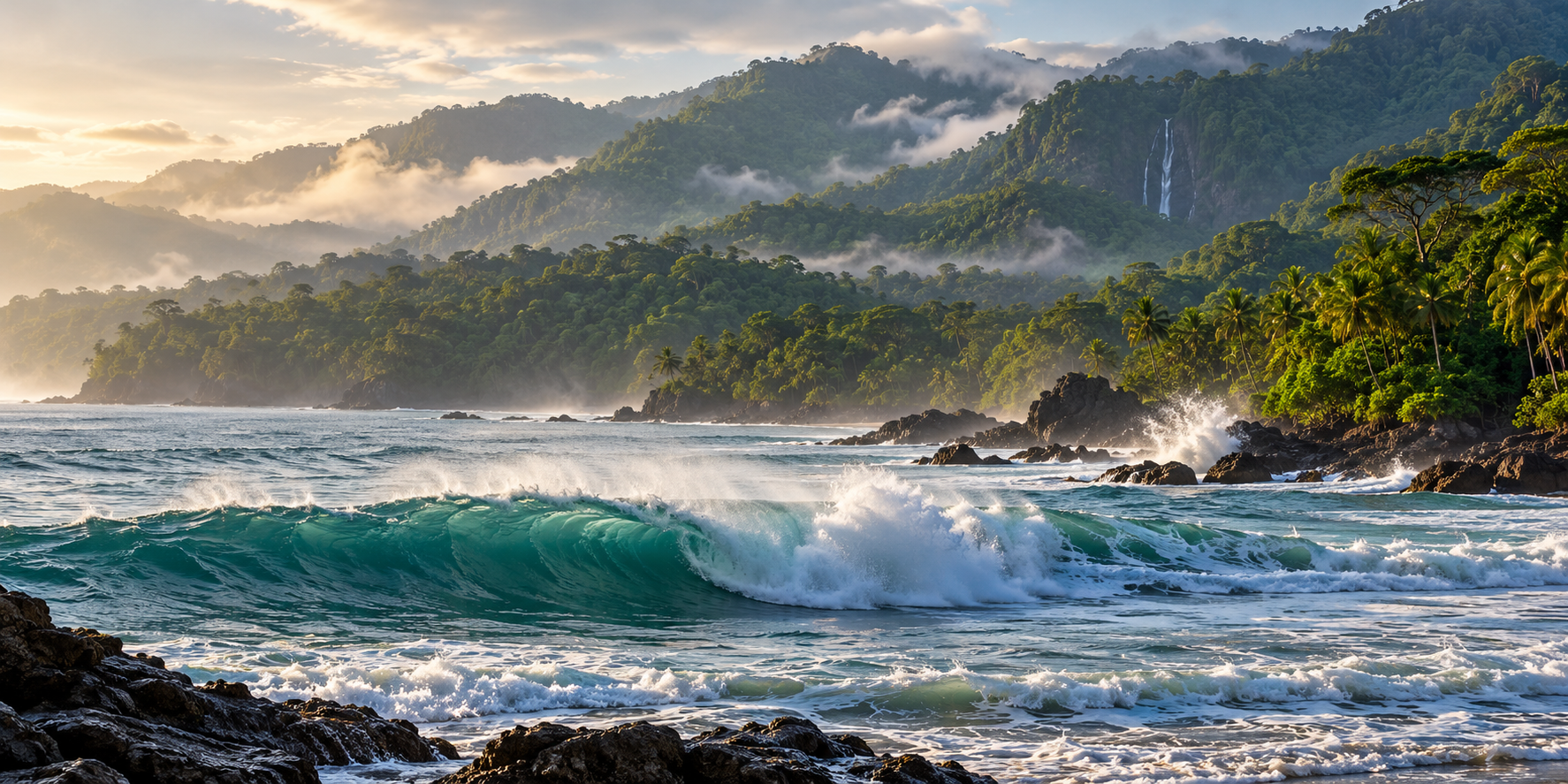
Illustrative AI-generated image created for this story; it is not a documentary photograph.
The first thing I noticed in Dominical was not a wave. It was the sound of one somewhere beyond the trees, a long low rush that seemed to continue after the water itself had already folded onto the beach. The road had carried me south through changing shades of green, and suddenly the Pacific was close enough to hear. I had imagined a neat choice for the day: beach or waterfall. Dominical unsettled that choice. The town seemed to belong to the narrow meeting place between the ocean and the steep, wet hills behind it. I wanted to spend time with both sides of that landscape.
In the morning I walked toward the sand without carrying a board. Surfers were reading the water, but I was still learning the shore. The waves were powerful enough to make watching feel like an activity in its own right. One swell rose, held its shape for a moment, then broke with a force I could feel through the soles of my feet. Another looked promising from a distance and dissolved before it reached the people waiting outside. I could not tell what decision each surfer was making. I could tell that nobody was commanding the ocean.
The temptation, in a surf town, is to turn every visitor into a surfer. I did not need that role to feel included in the morning. I stood well clear of the break, listened to the repetitions of the water, and let the scene teach me patience. If I wanted a lesson, I would ask a qualified local instructor about conditions and a suitable place. I would not assume that the most dramatic wave I could see was the right place to begin. For now, I was happy to be an attentive person on the beach.
There was a looseness to the town that suited that decision. I could move from shade to open light, pause for coffee, and return to find the water in a different mood. The day had no need for a long list of attractions. I had come from a life where every hour was spoken for, and this coast seemed to ask one question: what would happen if I let a morning remain a morning?
The road inland
By midday I wanted to see why waterfall country and surf town so often appear in the same description of this region. The hills behind Dominical were no longer a green backdrop once I turned toward them. They were ridges and valleys, layers of forest, changes in temperature and light. Clouds hung over the higher ground. A drive inland felt like a change of scene without leaving the larger story of water behind. The rain that fed a cascade and the waves I had watched belonged to connected, if very different, rhythms.
Nauyaca was the waterfall I had in mind. There are different approaches to the falls, and access is managed by separate operators, so I would confirm the entrance and current conditions before setting out rather than assume that any sign bearing the name led to the same route. I chose the private Nature Park approach, mindful that its published options and access details could change. The important thing in the story was not a particular ticket or vehicle. It was the decision to slow down as the coast gave way to forest.
The trail drew my eyes upward. I found myself looking for the source of every flicker in the canopy and discovering only leaves turning in the breeze. That was enough. A forest does not owe a visitor a rare animal on cue. It offered a hundred smaller changes: a different density of shade, a dampness in the air, the sound of moving water gradually becoming distinct from wind. I walked carefully where the ground asked it of me and accepted that a waterfall outing is partly about the path to the water.
The cascade came into view as a pale movement against dark rock. I had known, from photographs, that it was large. That knowledge did not prepare me for the way its sound filled the space. The water seemed to fall in several registers at once: a deep roar from above, a sharper splash where it struck, and the restless conversations of the pools below. I stayed back long enough to take in the whole scene before choosing where to stand next. The stone around a waterfall can be slick, and the water's force is not something a pretty image can measure for me.
I watched mist drift across a patch of sunlight. It made the air visible. The beach had been wide and outward-facing; here the forest held the view close. The two places did not compete. Each changed my sense of the other. The morning's surf had looked immense, yet the waterfall made a different kind of power tangible. Both asked for respect before participation.
The time between destinations
It would have been easy to turn the waterfall visit into a single triumphant sentence: we went, we saw, we returned. That would have missed the hours when I was simply somewhere unfamiliar. I remember the weight of the humid air and the way my eyes needed time to adjust after a bright clearing. I remember stopping to hear water before I could see it. I remember thinking about the people who manage paths and access so visitors can encounter the place without treating it like an untended stage set.
At the falls, I did not try to collect every vantage point. I chose one where I could sit and let the scene rearrange itself. From there the water was never still, but the scene was not chaotic. It had patterns: a ribbon that remained white even when the light shifted, a darker section of rock that appeared only as spray lifted, a pool whose surface moved differently near its edge. I began to understand why travelers return to a place they have already photographed. A picture may record the outline; it cannot hold the long act of noticing.
I also noticed my own desire to give the scene a name and move on. Perhaps it was a habit learned from short vacations: identify a landmark, take the expected picture, and hurry toward the next one. The waterfall made that habit seem especially strange. Its defining quality was motion, and I could not understand it in a single glance. I stayed long enough for the first astonishment to pass. After that came subtler things: the way mist softened one wall of rock but left another sharply drawn, the different voices of water dropping from different heights, the quiet between louder bursts. There was no better photograph waiting at the end of this attention. The attention itself was the reward.
If I had been traveling with someone whose pace differed from mine, this would have been the moment to leave room for both of us. One person could rest in the shade while another lingered at a viewpoint. A family might decide that the outing had already been full before reaching every corner. A good day in the forest is not measured by how many paths I can fit into it. I liked imagining an itinerary that gave us the freedom to choose, with reliable local knowledge about access and conditions but no pressure to turn nature into a list of completed tasks.
On the way back toward Dominical, I felt the first change in the air that told me the coast was near. It is remarkable how quickly a landscape can move from enclosed green to open sky. I wondered whether I would recognize the beach's sound after the waterfall's roar. I did. The two sounds seemed to occupy different parts of the same day. One fell toward the earth, the other pushed toward it from the horizon.
When I reached town again, I had no urge to describe the day as an adventure conquered. The shore had allowed me to watch. The forest had allowed me to walk. The waterfall had made me quiet. None of those experiences required a performance from me. I could have arranged a surf lesson on another day, taken more time in the hills, or simply stayed at the beach. A carefully designed Costa Rica journey can make room for that kind of choice instead of packing every beautiful place into a race.
Evening on the Pacific
I returned to the beach as the light changed. The surfers were still reading the waves, though the scene felt different from the morning. The coast had taught me enough to see that the water was not one continuous condition. Sets arrived and passed. People waited. A wave that looked gentle from far away stood up suddenly near the sand. I kept my distance and watched as color left the sky slowly, not all at once.
I thought about what I would tell a friend considering Dominical. I would tell them to come for the unusual closeness of surf and hills, for the chance to hear the Pacific in the morning and moving river water later in the day. I would also tell them that conditions matter. A beach with powerful surf deserves local advice and a healthy respect for currents; a waterfall outing deserves attention to weather, access, and the operator's guidance. None of that makes the place less inviting. It makes the invitation real.
I had begun the day asking whether I should choose the beach or the waterfall. By evening the question felt too small. Dominical was interesting because I could move between different kinds of water and let each one change my pace. I could spend an hour watching without needing to participate, then spend an hour walking without needing to arrive quickly. The story of the place was in the transitions as much as in its highlights.
Even the journey between them had stayed with me. I had watched the open coast fall away in glimpses and the vegetation gather close, then made the trip in reverse with salt still on my skin and the sound of the falls in my ears. The distance on a map would tell only part of that story. The change in atmosphere made it feel as though I had moved through several versions of Costa Rica in one day. That richness is a reason to resist a hurried schedule. The region rewards a person who can give both the shore and the hills their own hours.
As darkness approached, the sea became more sound than view again. I stood where I had stood that morning, but I did not feel as if I had returned to the same point. I had carried the forest back with me: the shade, the damp air, the echo of the falls. The waves made a long rush beyond the trees, and I knew that tomorrow they would sound familiar without ever being exactly the same. That is the kind of Costa Rica journey I would want to plan again: one with enough care to reach extraordinary places and enough room to actually feel them.
Editorial note: This first-person travel story is an illustrative, researched narrative created for inspiration. It does not describe an actual visit by a Costa Rica Travel Professionals staff member or customer. The accompanying image is AI-generated and illustrative.
A world of wonder awaits
Plan your Costa Rica adventure
Tell our destination concierges what you want from Costa Rica, and we will help shape the journey.