Caño Island: A Marine Reserve Day | Costa Rica Travel Professionals
Travel Stories
Caño Island: A Marine Reserve Day
The island was still a shape on the horizon when I began to understand why a day on the water feels different from a day on land. There was no trail to follow with my eyes, no turn in a road to anticipate. The boat moved across a
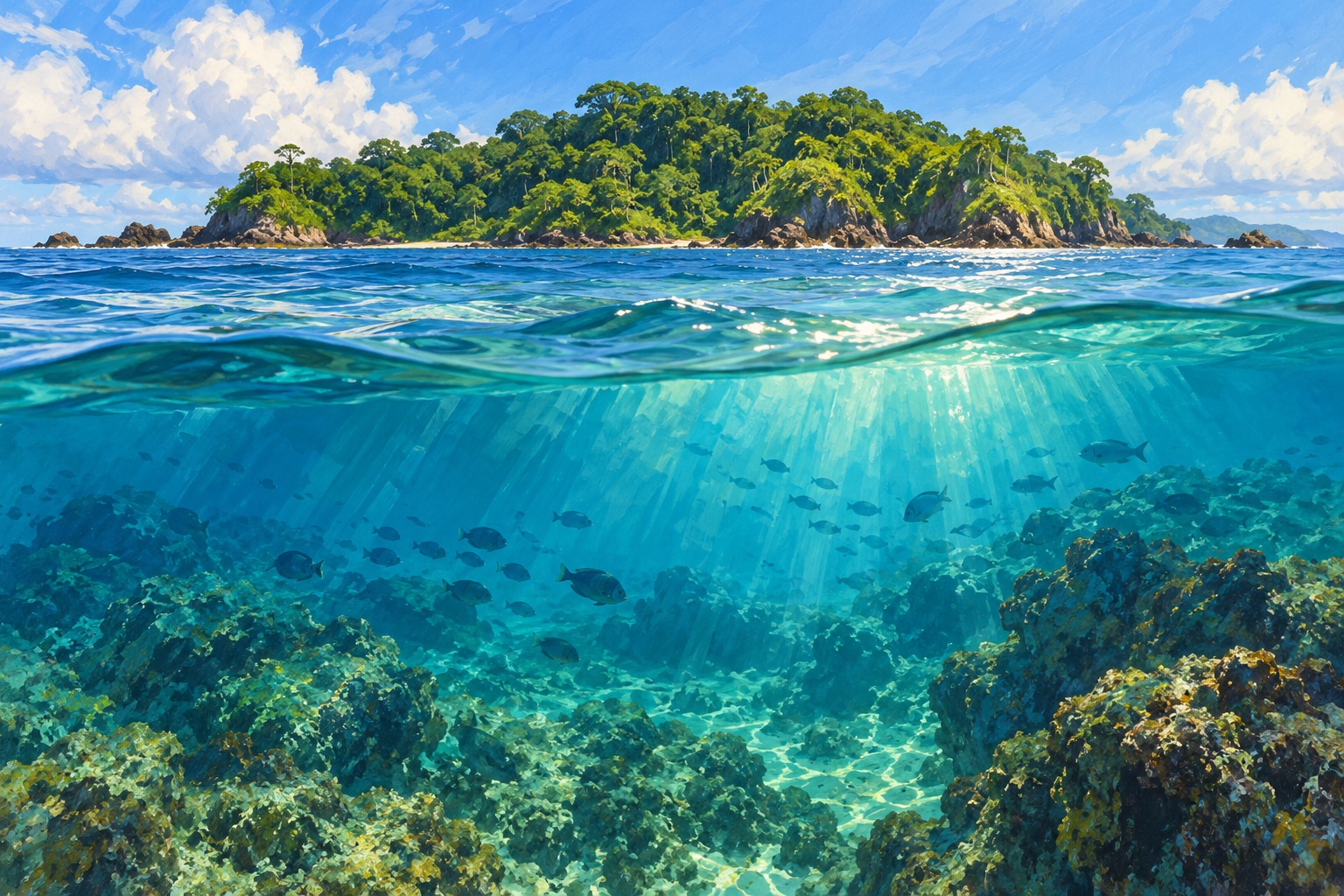
Illustrative AI-generated image created for this story; it is not a documentary photograph.
The island was still a shape on the horizon when I began to understand why a day on the water feels different from a day on land. There was no trail to follow with my eyes, no turn in a road to anticipate. The boat moved across a broad surface that changed color as clouds crossed the sun. I held my gaze on the low green outline ahead, but my attention kept returning to the water between us. Caño Island is a protected biological reserve, and I was arriving as a guest in a marine environment whose life would continue regardless of what I managed to see.
Before departure, I had listened carefully to the safety briefing. It was tempting to treat such instructions as the dull preface to the beautiful part, yet the briefing gave the day its shape. Where we could go, what we could touch, and how we would respond to changing conditions were not arbitrary limits. They were part of visiting a place that Costa Rica had chosen to protect. I checked my gear and asked a question when I was unsure. Curiosity seemed more useful than pretending confidence. The sea can look calm from shore and still ask for serious attention once you are in it.
As the island grew nearer, I tried to resist filling the water with imagined animals. A travel photo can make a sighting look inevitable. Real marine life is free to be elsewhere, and visibility changes with weather and water. What I could count on was the experience of being above a living system and, if conditions allowed, entering it with care. I watched the boat's wake spread and disappear. Every bright patch beneath the surface drew my eye. I was excited, but I wanted the excitement to make me attentive rather than demanding.
The guide described the boundaries and the rhythm of the outing, with instructions that would take precedence over any plan in my head. I knew from SINAC's information that the reserve included the island and surrounding marine area and that visitor use is managed. That fact changed how I saw the shoreline. It was not simply a backdrop for a snorkeling story. It was part of a protected place with rules and ecological reasons behind them. I adjusted my mask, took one more look at the boat, and waited until the group was ready.
Entering the water narrowed my world to breath and movement. The surface that had seemed flat from the boat became a shifting ceiling of light. I kept my fins away from anything below and let myself float before trying to identify shapes. The first gift was not a named species; it was the feeling of moving slowly enough to see layers. Near me, water held flecks of brightness. Farther down, forms appeared and softened as I changed angle. I did not need a perfect underwater tableau. The change in perspective was enough to make the morning feel immense.
I remembered to look back toward the boat now and then. Keeping oriented was part of staying relaxed, and I followed the guide's direction rather than drifting after a shape that interested me. Underwater, distance can be deceptive. A dark patch might be close or far; a fish can vanish in a flicker of light. I enjoyed that uncertainty when it was held within sensible boundaries. It made each observation feel discovered rather than supplied. The reserve offered an encounter with a whole environment, not a promise that certain creatures would line up for my camera.
At one point I paused almost completely, letting the water support me. The quiet was not actually silent. My breathing made its own rhythm, and the sea carried small sounds I could not identify. Sunlight broke into moving bars. I felt both small and alert. From a boat, the ocean asks me to look across. In the water, it asks me to look around and down. I could imagine returning to the boat with only a few reliable identifications, yet with a stronger memory of the changing light than of any checklist.
Back aboard, I listened as others described what they had noticed. I was careful not to borrow their sightings as my own. Their excitement added to the atmosphere, but my story would be about what I had imagined experiencing, not a stitched-together inventory of other people's claims. We drank water and looked toward the island. The shore seemed closer now, and I could see that its green surface was textured rather than smooth. I wanted to ask how conservation staff balance visitors' desire for access with the reserve's needs. The question stayed with me through the next part of the day.
The afternoon water looked different from the morning water. Clouds had shifted, and the boat's shadow crossed a darker surface. I was reminded that a marine excursion is always conditional. Current reserve rules, permitted sites, and the guide's judgment determine what happens. A story written later can seem as if every step was inevitable; a real visit requires flexibility. I liked having that truth close at hand. It kept me from turning a protected island into a personal stage set and let me appreciate the decisions that made our safe visit possible.
I had brought a small camera, but I used it sparingly. Underwater photography can encourage a person to chase a subject, crowd others, or forget where their fins are. I preferred to remain aware of my body and the group. When something moved beneath me, I watched first. An image would be a bonus, not proof that I had encountered the place correctly. I thought about how many photographs I had seen online of turtles, rays, and fish, and how easily those images create expectations. I left room for whatever the sea actually revealed.
There is an appealing simplicity to an island seen from a distance: green land, blue water, a clean horizon. Up close, the simplicity dissolved. Water shifted through shades I could not name. The rock and vegetation had edges and irregularities. Wind changed the surface minute by minute. I felt lucky to witness even a small fraction of it. Costa Rica's conservation system had given the place a formal boundary, but the living world did not arrange itself into neat compartments. The marine area, the island, and the distant Osa coast were connected in ways a short visit could only begin to suggest.
I considered the stories I might tell after returning to the mainland. It would be easy to lead with a grand claim about “untouched” water or guaranteed wildlife. Neither would be fair. A protected reserve still requires management and human care; marine animals move according to their own needs. The truer story would describe the texture of the day: the approach by boat, the deliberate briefing, the first breath through a snorkel, the contrast between sunlight on the surface and the subdued colors below. Those details were enough to make the trip feel vivid without inventing a spectacle.
On the return journey, I rested my hands on the side of the boat and watched the island become smaller. I could no longer separate its outline from the larger thought of the reserve. Protection was not a sign posted at the edge of an attraction. It was a series of choices, from national policy to the behavior of a visitor who chose not to touch the life below. My own part was small. That did not make it meaningless. Every person entering the water decides how carefully to move through it.
The sea beyond the boat looked expansive again, and I remembered the moment when I had floated almost still. I had not controlled what appeared beneath me. I had controlled whether I stayed aware, whether I followed guidance, and whether I left the place as I found it. The difference matters. Traveling thoughtfully is not a way to guarantee wonder; it is a way to remain worthy of an invitation. Caño Island made that idea feel physical, expressed through breath, balance, and a careful distance from the world below.
When the Osa coast came back into view, I found myself reluctant to rush onto the next outing. A marine day has its own afterglow. Salt dried on my skin. The movement of the boat seemed to continue for a moment after we stopped. I wanted to sit somewhere quiet and let the images settle before turning them into a summary. The best of the day was not a single dramatic frame. It was the way my senses had been rearranged by time on and in the water, and the way the protected island remained itself as I left.
That evening I considered what I would say to someone planning the same kind of trip. Start with the official reserve information and a qualified operator. Let current conditions decide what is appropriate. Do not expect a particular animal or treat a marine habitat as a touch pool. Bring the ordinary things that make a water outing comfortable, but leave room for the extraordinary fact that a living place has no obligation to follow an itinerary. If the sea offers a clear view, enjoy it. If it offers a quieter lesson in attention, that too is worth the journey.
The memory I would carry was of the island first appearing as a small shape, then growing complex as we approached, then becoming small again on the return. My understanding had moved in the opposite direction. I began with an attraction named on a map and ended with a deeper sense of a reserve that extends beyond what any visitor can see in a day. The water held far more than my story could contain. I was glad to leave it that way, grateful for a brief, careful look into a world that did not need me to complete it.
I also thought about the people who never enter the water and still make a visit possible: conservation staff, boat crews, guides, and the coastal communities that live beside these waters. My day had seemed wonderfully simple once it was underway, yet simplicity for a guest can rest on a great deal of work. Remembering that work changed my idea of a good excursion. I wanted the operator to treat the reserve's limits as real, to explain decisions clearly, and to place care ahead of a photograph. I wanted to be the kind of guest who accepted a changed plan without resentment. In a marine reserve, the ability to adapt is part of respect for the place and for everyone responsible for it.
Even after I had changed clothes, the feel of floating stayed in my shoulders. I could recall the effort of moving gently, the deliberate check for the boat, and the moment I stopped looking for a single impressive creature and began seeing the water itself. That shift was the day's real discovery. It would travel home with me more reliably than a list of sightings, and it might change how I approached the next protected place I visited.
Editorial note: This first-person story is an illustrative narrative composed from research. It does not describe an actual visit by a Costa Rica Travel Professionals staff member or customer. Marine conditions, wildlife, permitted activities, and reserve access vary; follow current SINAC rules and qualified local guidance. The accompanying image is AI-generated and illustrative.
A world of wonder awaits
Plan your Costa Rica adventure
Tell our destination concierges what you want from Costa Rica, and we will help shape the journey.