Cahuita: Coastal Trail and Caribbean Rhythm | Costa Rica Travel Professionals
Travel Stories
Cahuita: Coastal Trail and Caribbean Rhythm
The first thing I noticed in Cahuita was how much room the morning seemed to have. I had arrived with the usual collection of travel habits: a phone full of saved places, a loose schedule, and the reflex to ask what came next. Yet
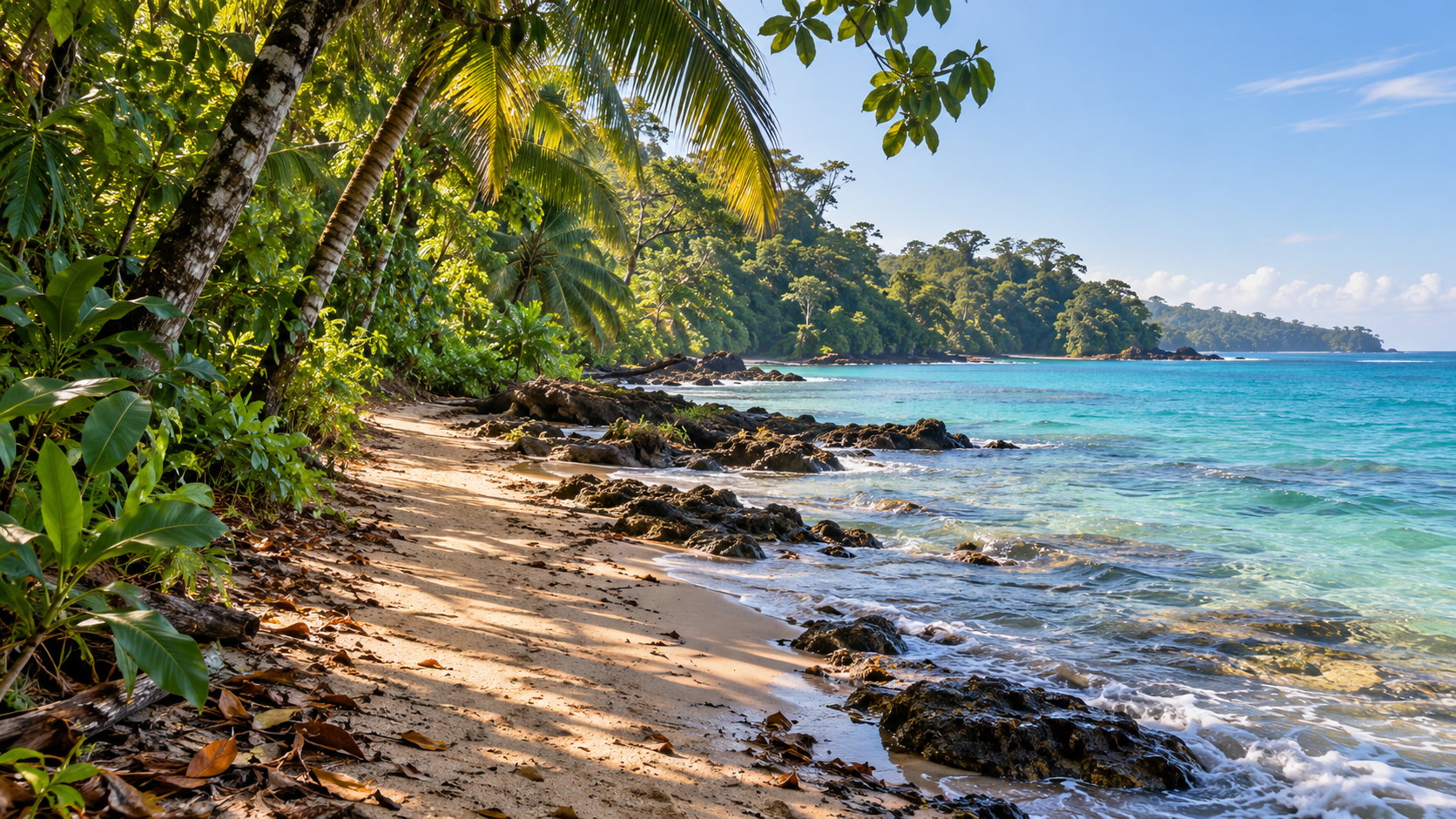
Illustrative AI-generated image created for this story; it is not a documentary photograph.
The first thing I noticed in Cahuita was how much room the morning seemed to have. I had arrived with the usual collection of travel habits: a phone full of saved places, a loose schedule, and the reflex to ask what came next. Yet the village met me with a gentler question. What if I stayed with what was happening now? A bicycle rolled past a painted wall. Somewhere a door opened and the aroma of breakfast drifted into the street. Beyond the houses, the sea was close enough to make itself heard, a low, patient sound beneath the conversation of birds. I followed that sound toward the coast, carrying water and no particular ambition to cover a certain distance. I wanted to understand the place at walking speed.
At the edge of Cahuita National Park, the forest and beach appeared to be having a quiet conversation of their own. Leaves cast complicated shadows across the path; beyond them, a strip of pale sand caught the light. The trail did not demand a dramatic entrance. One moment I was aware of the village behind me, and the next I was moving between two worlds, with trunks and vines on one side and the Caribbean on the other. I had imagined that a coastal walk would be mainly about the sea. Instead, my attention kept crossing the trail, pulled by a rustle in the canopy and then by the white line of a wave. Each turn offered a new way to listen.
The air felt different under the trees. It had the soft weight of a place that receives rain, and the ground gave back a faint earthy smell. I slowed when the light shifted across a tangle of roots, then slowed again simply because I could. Nothing I saw needed to become a checklist. A bird's call came from somewhere above me, impossible to place among the layers of green. I waited for it to repeat, and when it did, I still could not find the singer. That small failure felt unexpectedly satisfying. The forest was more than a display arranged for visitors; it remained full of lives continuing whether I identified them or not.
When a break in the trees opened toward the beach, I stepped out of the shade and felt the sun on my shoulders. The transition was immediate but not abrupt. The same breeze that moved the leaves crossed the sand and lifted the edge of my shirt. I watched the water fold over itself and retreat, leaving a brief reflection of sky before the next wave erased it. There were places where the shoreline looked inviting, but I did not assume every beautiful patch of water was a safe swimming spot. Conditions can change, and the park's guidance matters more than any picture in a travel brochure. For now, walking beside the sea was enough.
The most memorable part of that first stretch was the way the path let me look both inward and outward. In the forest, I studied details: a leaf with a torn edge, an insect crossing the path, a branch holding a bead of water. On the beach, my eyes traveled to the horizon. I realized that the pleasure of Cahuita was not choosing one view over the other. It was the rhythm between them. I would walk a few minutes enclosed by vegetation, emerge to hear the surf clearly, and then return beneath the trees with the ocean still in my ears. The landscape seemed to teach its own pace.
I had considered joining a local guide, and I could see why one would change the experience. An experienced pair of eyes could connect sounds and movements that escaped me, while also grounding a visit in the knowledge of people who live here. The Costa Rican Tourism Board describes community guides working with the park, an important reminder that this protected coast is also part of a living community. Even without turning the walk into a wildlife inventory, I found myself paying closer attention. A guide could help me read the place; my own task was to remain curious and respectful, keeping distance from wildlife and leaving everything I found where it belonged.
Near the shore, sunlight caught the surface of the water in broken pieces. I sat where the sand stayed dry and watched the pieces rearrange themselves. I could feel my earlier plans loosening. I had expected to spend my time asking how far the trail went and whether I was missing a better viewpoint ahead. Instead, the best viewpoint was where I happened to stop. The trees stood behind me; the sea moved in front. Somewhere along the path, other walkers passed quietly. For a while I did nothing useful in the ordinary sense, and the lack of purpose made the morning feel unusually full.
Cahuita's appeal is easy to flatten into a few adjectives: tropical, relaxed, beautiful. Those words are true enough as impressions, but they miss the texture of a place where a national park sits beside a town with its own routines. I did not want to treat the village as a decorative entrance to the trail. When I walked back, I noticed the small exchanges I had overlooked on my way out: someone greeting a neighbor, someone sweeping a threshold, a conversation that continued after I passed. I could be a guest here without claiming to know the story of the people around me. Respect began with recognizing that the town was not waiting for my arrival to become real.
Lunch became a pause rather than a reward for finishing a hike. I sat down hungry, with warm feet and the faint salt of the coast on my skin. I resisted the urge to turn a meal into an endorsement of a particular restaurant or a promise about what would be on a menu. The pleasure was simpler: time to taste what had been prepared, time to look up from my phone, time to let the morning settle. The sounds from the street came and went. I understood that the rhythm I had felt on the trail did not stop at the park boundary. It followed me back into the village if I allowed it.
In the afternoon I returned toward the water, though I did not try to repeat the morning. The light had changed, and the shadows fell at new angles across the path. That is one of the quiet gifts of a place explored slowly: familiar ground is never quite the same twice. A patch of sand I had crossed without thinking now held the intricate marks of small movements. A cluster of leaves glowed from behind. The sea, which had seemed silvery earlier, looked deeper in color. None of these changes was an attraction with a sign. They belonged to the ordinary passage of the day.
I thought about the reef associated with Cahuita and about how easily admiration can become careless. A protected marine environment is not an invitation to touch or take. If I chose a water activity, I would follow current park rules and the advice of qualified local guides, including where access was permitted and what the conditions allowed. It was enough that the reef existed beyond the visible edge of my walk, part of the larger living system that made this coast distinctive. I did not need to claim a snorkeling experience I had not planned into this imagined day, or promise a guaranteed encounter beneath the surface.
The coast also made me think differently about photographs. Every few minutes there was something that looked like the perfect image: a bend in the path, a leaning palm, a bright opening between darker trees. But I found that taking fewer pictures helped me remember more. Without a screen between me and the scene, I noticed the brief coolness when a cloud passed over the sun. I heard the separate sounds of wind in leaves and waves on sand. I carried away details too small to prove that I had been somewhere, yet strong enough to bring the place back later. Perhaps that was what I had come for.
As the afternoon softened, I walked without trying to reach a final landmark. I had water, sensible shoes, and enough time to turn around when I was ready. That flexibility felt like a luxury. Some journeys are built around a hard-won summit or a reservation at a precise hour. Cahuita offered another kind of richness: the freedom to let a stretch of coast take the time it deserved. I imagined how a carefully planned Costa Rica itinerary could protect this open space rather than fill it. The most thoughtful arrangement might be the one that leaves a morning free to grow longer.
I paused once more beneath the trees, where the sea appeared in fragments through the foliage. The park's two worlds met there without competing. A wave arrived and vanished. A leaf trembled, then went still. I felt no need to name every sound. The longer I remained, the more obvious it became that attention was a form of participation. I could not make the forest reveal itself on command, and I could not hold a particular light over the water. I could only be present while the place went on being itself.
Back in the village, I noticed how quickly I had become accustomed to moving slowly. I was no longer measuring the day in completed stops. I was recalling a sequence of small transitions: street to trail, shade to sun, leaf to horizon, silence to surf. The story of the day did not need a surprise ending. It had changed my sense of scale. A single coastal walk had contained more than I could fully take in, and I liked knowing that there was more beyond my understanding. Travel can be generous that way. It can leave room for humility alongside delight.
When evening approached, the sea became a sound again rather than a view. I could hear it while I thought about what I would carry into the next part of a Costa Rica journey. Not a list of species spotted or a claim that I had found the one perfect beach. I would carry the feeling of a place where forest and water remain close, and where a traveler can meet them without rushing. Cahuita had not asked me to conquer a trail. It had invited me to follow a rhythm, to notice the lives around me, and to let the day unfold at the pace of the Caribbean coast.
The morning had begun with a question about what came next. By the time the light thinned, I had a better one: what had I nearly missed while looking ahead? I remembered the unidentified bird, the moving shade, the wave that briefly held the sky. Those moments were modest and unrepeatable, which made them feel more precious. I could imagine returning with a knowledgeable local guide, taking a different stretch of path, or simply sitting beside the sea again. The possibilities remained open. What mattered now was the discovery that a day did not need to be crowded to feel complete.
That is the version of Cahuita I would want to make space for in a larger trip: a village approached as a community rather than a backdrop, a protected park entered with care, and a coastline experienced with enough time to notice its changing light. The path could be part of a journey designed around nature, culture, rest, and the particular interests of the people traveling. It need not be made into a race. I arrived carrying the urgency of elsewhere. I left imagining a different measure of a good day, one shaped by the slow conversation between trees and sea.
Editorial note: This is an illustrative first-person story, imagined from research to inspire travel. It does not describe a real visit by Costa Rica Travel Professionals staff or a customer. Check current park guidance and local conditions when planning. The accompanying image is AI-generated and illustrative.
A world of wonder awaits
Plan your Costa Rica adventure
Tell our destination concierges what you want from Costa Rica, and we will help shape the journey.